

Not every benefit applies to every ultrasonic meter. The strongest retrofit advantages belong to clamp-on ultrasonic flow meters, where transducers sit outside the pipe. Measurement quality still depends on fluid condition, pipe construction, velocity profile, sensor placement, and operating range. The useful question is therefore not only what the advantages are, but when they actually hold.
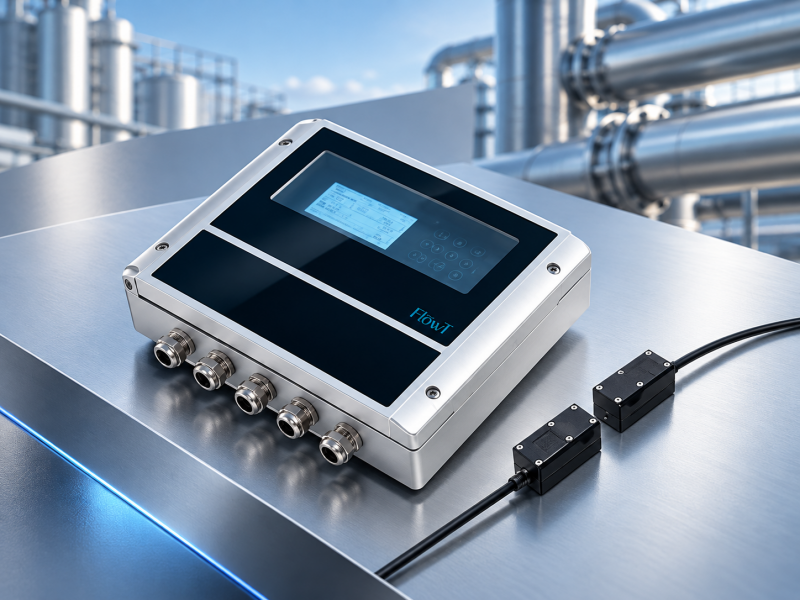
How Ultrasonic Flow Measurement Differs From Mechanical Flow Measurement
An ultrasonic flow meter uses acoustic signals to determine fluid velocity rather than relying on a rotating turbine, gear, or other mechanical element in the flow stream. In a transit-time ultrasonic flow meter, two transducers send signals with and against the direction of flow. The small difference between upstream and downstream travel times is used to calculate velocity and then volumetric flow.
Doppler meters work differently. They depend on reflected ultrasound from bubbles or suspended particles. That distinction matters because a clean liquid that suits transit-time measurement may not provide the reflective content required by a Doppler meter, while a liquid with heavy aeration or solids can weaken a transit-time signal. A more detailed transit-time vs. Doppler comparison is useful before selecting a measurement principle.
Clamp-On and Inline Ultrasonic Meters Are Not the Same
"Ultrasonic" describes the measurement technology, not the installation method. An inline ultrasonic meter becomes part of the pipeline. A clamp-on meter places the sensors on the outside of an existing pipe. This distinction prevents a common mistake: claiming that every ultrasonic meter can be installed without cutting the pipe or contacting the process fluid.
For retrofit work, clamp-on systems deliver the clearest installation advantage. Siemens lists installation without stopping production or cutting the pipe, no contact with the medium, no moving parts, and no measurement-related pressure drop among the benefits of its SITRANS FS220 clamp-on system.
1. Non-Invasive Installation Can Avoid Pipe Modification
On an operating plant, adding an inline meter can involve much more than the price of the instrument. The line may need to be isolated, drained, cut, welded or flanged, pressure-tested, and returned to service. On a critical utility or production line, coordinating that work can be more difficult than selecting the meter itself.
A non-intrusive ultrasonic flow meter avoids opening the pipe because the sensors measure through the pipe wall. This is especially useful for existing chilled-water, cooling-water, treated-water, and industrial utility lines where shutdown is inconvenient or temporary flow verification is required.
Non-invasive does not mean installation is casual. The pipe surface, sensor spacing, coupling, pipe data, and mounting position still affect the acoustic path. The advantage is that these tasks can often be completed without creating a new process penetration.
2. Clamp-On Measurement Adds No Obstruction to the Flow Path
Some flow technologies introduce a restriction or a moving element into the process. A clamp-on ultrasonic meter does not place anything inside the pipe, so the measurement point itself does not create an additional obstruction or measurement-related pressure loss.
This can matter on large water networks, HVAC loops, cooling circuits, and pump systems where unnecessary head loss eventually becomes an energy cost. It is more precise to say that clamp-on measurement adds no pressure loss than to say the piping system has "zero pressure loss," because the pipe, valves, fittings, and process equipment still create their own hydraulic losses.
3. No Moving Parts Reduces Mechanical Wear and Routine Service
Ultrasonic measurement does not depend on bearings, rotors, or gears to convert fluid motion into a reading. That removes several wear mechanisms found in mechanical meters and eliminates the risk of a rotating measuring element becoming slowed by wear or contamination.
For external sensors, there is another practical benefit: the transducers are not continuously exposed to the process fluid. That can reduce cleaning requirements in applications where a wetted sensor would otherwise see corrosive or contaminated media.
Low maintenance does not mean maintenance-free. A clamp-on installation still needs checks of mounting security, cabling, couplant condition where applicable, configuration, and measurement plausibility. When metrological confidence matters, verification or flow meter calibration should be part of the measurement plan. NIST's liquid flow calibration services show why traceability and uncertainty matter beyond a headline accuracy figure.
4. Ultrasonic Measurement Is Not Limited by Electrical Conductivity
An ultrasonic meter derives velocity from acoustic behavior rather than electrical conductivity. That makes suitable oils, hydrocarbons, deionized water, glycol mixtures, and other non-conductive liquids possible candidates, depending on the meter and acoustic conditions.
This is an important difference from an electromagnetic meter, which requires a conductive liquid. It is not, however, a universal-fluid advantage. Transit-time measurement still needs a usable acoustic path. Heavy aeration, high solids loading, severe attenuation, or an incompletely filled pipe can make measurement unstable or impossible.
5. Clamp-On Sensors Are Attractive for Existing and Large-Diameter Pipes
As pipe diameter increases, inline installation can require larger flanges, spool pieces, lifting equipment, more labor, and a longer shutdown. External sensors avoid replacing a full-bore pipe section, making clamp-on technology attractive on large existing pipelines.
The same installation flexibility supports different instrument formats. A wall-mounted ultrasonic flow meter suits permanent monitoring, while a portable ultrasonic flow meter can be moved between points for commissioning, troubleshooting, balancing, or temporary verification. The meter still has to match the pipe size, sensor frequency, liquid, temperature, and required performance.
6. Accuracy Can Be Strong, but Installation Conditions Matter
Accuracy is often presented as a simple product specification. In practice, ultrasonic flow meter accuracy depends on both the instrument and the installed measurement conditions.
Why Pipe Data Affect the Acoustic Path
A clamp-on system calculates sensor spacing and sound travel through the pipe wall and liquid. If the outside diameter, wall thickness, liner, pipe material, or fluid properties are entered incorrectly, the calculated acoustic path can be wrong. Endress+Hauser notes that pipe diameter, wall thickness, material, coating, and fluid sound velocity are important inputs for clamp-on systems, and that thick liners attenuate ultrasonic signals. Its ultrasonic flow measurement technical overview also explains why exact sensor positioning matters.
Why Flow Profile and Low Velocity Matter
A meter converts a measured acoustic velocity into an estimate of average pipe velocity. Elbows, partially open valves, pumps, reducers, and other disturbances can create swirl or an asymmetric velocity profile. If the measurement path does not represent the average profile well, the flow result can shift even when the electronics are working correctly. That is why straight-run guidance and a sensible sensor location still matter; FlowT's clamp-on sensor installation notes provide additional installation considerations.
Very low flow creates a different challenge. As flow velocity falls, the upstream/downstream transit-time difference becomes smaller. Zero offset, signal noise, and installation effects can then represent a larger share of the reading. This is why "high accuracy" should never be evaluated without checking the required minimum flow or velocity.
7. One Platform Can Support Permanent, Temporary, and Bidirectional Measurement
Many ultrasonic systems can determine both flow magnitude and direction from upstream and downstream acoustic travel. This helps on transfer lines, storage systems, looped networks, and processes that reverse flow. Bidirectional capability and turndown are model-specific and should be confirmed.
Ultrasonic technology also fits different measurement strategies. A plant may install permanent transmitters on critical utilities while using a portable unit to investigate pumps, verify balancing, or compare questionable readings at other locations. That flexibility can reduce the need to permanently instrument every diagnostic point.
Where Ultrasonic Flow Meters Have Important Limitations
The same acoustic principle that creates the advantages also sets the limits. A transit-time meter needs a sufficiently stable sound path. Bubbles scatter the signal; high solids concentrations can attenuate it; thick or poorly bonded liners can weaken transmission; corrosion can make pipe geometry uncertain; and a partially filled pipe may break the assumed measurement path entirely. Endress+Hauser likewise notes the importance of pipe construction, liner condition, sensor position, and acoustic transmission when applying clamp-on systems.
These conditions do not automatically rule out ultrasound, but they should trigger a more careful application review. Depending on the liquid, a Doppler meter or electromagnetic meter may be more appropriate. The answer changes with conductivity, solids content, pipe condition, accuracy, flow range, and installation constraints.
A Practical Selection Scenario: Existing Cooling-Water Line
Consider an existing cooling-water line that cannot easily be shut down. The pipe remains full, its material and wall thickness are known, the water contains little entrained air, and a usable straight section is available. Clamp-on transit-time measurement is a strong candidate because the application matches its main strengths.
If the same line had an unknown thick liner, severe corrosion, frequent air entrainment, or extremely low velocity, more verification would be needed. This is the useful way to judge ultrasonic flow meter advantages: connect each benefit to the condition that makes it possible.
Ultrasonic vs. Electromagnetic and Turbine Flow Meters
| Selection Factor | Clamp-On Ultrasonic | Electromagnetic | Turbine |
|---|---|---|---|
| Existing pipe without cutting | Strong fit | Usually requires inline installation | Usually requires inline installation |
| Moving measuring parts | No | No | Yes |
| Non-conductive liquids | Often possible | No | Often possible |
| Liquids with substantial solids | Application-dependent | Often suitable if conductive | Often less suitable |
| Temporary field measurement | Strong advantage with portable units | Limited | Limited |
An electromagnetic meter is often a strong option for conductive water and wastewater, including applications where solids make transit-time ultrasound difficult. A turbine flow meter can remain practical for clean liquids where an inline mechanical meter is acceptable. None of these technologies is universally superior; the useful comparison is based on the process and installation conditions.
What to Check Before Choosing an Ultrasonic Flow Meter
- Fluid name and whether it contains bubbles or suspended solids
- Pipe outside diameter, wall thickness, material, and liner information
- Minimum, normal, and maximum flow rate or velocity
- Fluid and ambient temperature
- Whether the pipe remains completely full
- Available upstream and downstream straight run
- Required accuracy or measurement uncertainty
- Permanent, portable, clamp-on, insertion, or inline installation preference
- Required outputs such as 4-20 mA, pulse, RS485, or other communications
- Whether the measurement is for monitoring, process control, verification, or billing
These details are more useful to a supplier than pipe diameter alone. Two pipes of the same nominal size can require very different solutions if one carries clean chilled water and the other carries aerated process liquid through a lined, corroded pipe.
Frequently Asked Questions
What is the main advantage of an ultrasonic flow meter?
For an existing liquid line, the main advantage is often the option to measure flow non-invasively with external clamp-on sensors. This can avoid pipe cutting, reduce installation disruption, and add no obstruction to the flow path.
Do ultrasonic flow meters cause pressure drop?
A clamp-on ultrasonic meter adds no sensor or restriction inside the pipe, so the measurement system itself does not add pressure loss. Inline ultrasonic meters should be evaluated according to their own flow-tube design.
Are ultrasonic flow meters accurate at low flow?
They can be, but low flow is more demanding because the measured transit-time difference becomes smaller. The meter's specified low-flow performance, zero stability, pipe data, mounting quality, and actual minimum velocity should be reviewed together.
Can ultrasonic flow meters measure wastewater?
Sometimes. Relatively clean wastewater may suit transit-time measurement, while liquids containing enough suspended material may suit Doppler measurement. Heavily aerated or solids-rich conductive wastewater may be a better candidate for another technology, such as an electromagnetic meter.
Does a clamp-on ultrasonic meter need a full pipe?
For conventional closed-pipe transit-time measurement, the pipe should remain full at the sensor location. Air pockets or a partially filled pipe can interrupt the assumed sound path and produce unstable or invalid readings.
Final Thoughts
Ultrasonic flow meter advantages become meaningful only when the application supports the acoustic measurement. With a full pipe, known pipe data, a suitable liquid, and a usable flow profile, ultrasonic technology can provide low-disruption installation, no added flow obstruction, low mechanical wear, and flexible monitoring.
Before selecting a meter, verify the fluid, pipe construction, velocity range, installation location, accuracy requirement, and measurement purpose. That application review is what turns a list of benefits into reliable field performance.


