

FlowT provides both clamp-on and insertion ultrasonic solutions for different pipe sizes and site conditions. For supported configurations and suitable installations, measurement accuracy can reach ±0.5%, while FlowT's signal-processing design is intended to support stable measurement at low velocity. Buyers who need a broader overview can compare the available ultrasonic flow meter options before selecting a configuration.
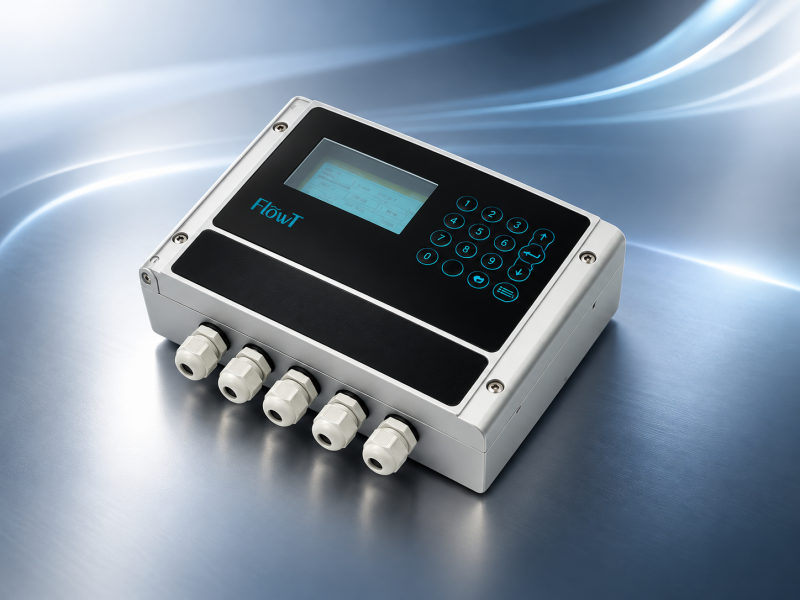
How a Water Ultrasonic Flow Meter Works
Most industrial water ultrasonic meters use the transit-time principle. Two transducers send ultrasonic signals both with and against the direction of flow. When water is moving, the downstream signal travels slightly faster than the upstream signal. The meter measures this transit-time difference and converts it into liquid velocity and volumetric flow using the entered pipe data.
This principle is explained in more detail in FlowT's ultrasonic flow measurement principle resource and in Endress+Hauser's explanation of ultrasonic flow measurement. The important point for selection is that the meter does not measure flow independently of the pipe. Accurate pipe dimensions, material information, transducer positioning and a usable acoustic signal all matter.
FlowT's current design states that the upstream/downstream transit-time difference can be resolved below 2 nanoseconds on supported configurations. This timing capability is relevant to low-flow sensitivity, but it should not be treated as a stand-alone accuracy specification. Actual performance still depends on the application, installation and signal quality. For a deeper explanation of this measurement method, see the transit-time ultrasonic flow meter page.
Why Use Clamp-On Ultrasonic Measurement for Water?
No Pipe Cutting for Retrofit Projects
With a clamp-on ultrasonic flow meter, the transducers are mounted on the outside of the pipe. This allows many existing water systems to be instrumented without cutting, welding or inserting a measuring element into the flow path. It is particularly useful when a production line, HVAC loop or utility-water system is already operating and shutdown would be costly.
No Added Obstruction in the Flow Path
External sensors do not create an internal restriction, so the clamp-on arrangement adds no pressure loss from a meter body or intrusive measuring element. It also keeps the transducers out of direct contact with the liquid. This can simplify retrofit measurement on selected corrosive or chemically treated water lines, although pipe material, wall thickness, lining and acoustic transmission must still be checked before selection. A non-intrusive flow meter is therefore useful when preserving the existing pipeline is a priority.
Permanent or Portable Monitoring
For continuous monitoring, a wall-mounted ultrasonic flow meter for water can remain connected to automation or energy-management systems. For commissioning, temporary surveys, pump checks and verification work, a portable ultrasonic flow meter may be more practical because the instrument can be moved between measurement points.
Measurement Performance and Low-Flow Capability
FlowT states that applicable water-ultrasonic configurations can reach accuracy of ±0.5% under suitable measurement conditions. The original design also targets a zero or very-low-flow range below 0.03 m/s. These figures should be matched to the exact model and operating conditions rather than treated as universal values for every pipe and liquid.
Low-flow measurement is demanding because the difference between upstream and downstream transit times becomes smaller as velocity decreases. Pipe dimensions, transducer spacing, coupling, signal strength, flow profile and zero stability become increasingly important. FlowT's ultrasonic flow meter accuracy information provides additional context for buyers comparing measurement performance.
When low velocity is a critical purchasing requirement, provide the expected minimum, normal and maximum flow rather than only the pipe diameter. FlowT can then review whether the selected ultrasonic configuration provides enough usable velocity and signal margin for the application.
Typical Water Applications
Water ultrasonic meters are most useful when the pipe is full and the liquid provides a stable acoustic path. Common applications include chilled and hot water loops, cooling and circulating water, process water, clean utility water, municipal water systems, treated water and selected industrial water pipelines. FlowT lists additional examples in its ultrasonic flow meter application resources.
- HVAC and building energy: monitoring chilled-water and hot-water circulation, balancing systems and supporting energy calculations. Projects that also calculate thermal energy can review an ultrasonic flow meter for BTU cooling water.
- Water treatment: measuring raw water, treated water, process water and transfer lines where external installation reduces pipe modification.
- Industrial cooling: tracking cooling-water and circulating-water flow around heat exchangers, production equipment and utility systems.
- Plant utilities: checking water consumption, pump performance and distribution between process areas.
- Commissioning and verification: temporarily checking existing meters or confirming actual operating flow before equipment adjustments.
What Must Be Confirmed Before Selection?
An ultrasonic meter should not be selected from nominal pipe size alone. Before quotation, the application should be reviewed as a complete measurement point. Endress+Hauser notes that clamp-on selection depends on information such as pipe outside diameter, wall thickness, pipe material, coating and the liquid's acoustic properties. Siemens' SITRANS FS220 overview likewise emphasizes the value of external installation for water measurement while noting that real installations must account for piping conditions.
| Selection Item | Information to Provide | Why It Matters |
|---|---|---|
| Liquid | Water type, additives, temperature, solids or bubbles if present | Determines whether the acoustic path is suitable |
| Pipe | Outside diameter, wall thickness, material and liner/coating | Required for sound-path and transducer-spacing calculations |
| Flow | Minimum, normal and maximum flow or velocity | Helps verify low-flow and full-range performance |
| Installation | Available straight pipe, nearby elbows, valves and pumps | Flow-profile disturbances can affect measurement |
| Signal | Required display, 4-20 mA, pulse, RS485 or other interface | Ensures compatibility with PLC, SCADA or BMS systems |
| Project | Permanent, portable, retrofit, OEM or verification use | Helps determine the most practical transmitter and sensor format |
Installation Conditions That Affect Accuracy
Correct sensor installation is as important as the transmitter itself. The pipe should be completely full at the measuring point, and the transducers need a clean mounting surface and correct spacing. Poor coupling, incorrect pipe parameters or installation too close to severe flow disturbances can produce unstable readings even when the meter itself is functioning normally.
Whenever possible, choose a straight section away from pumps, control valves, partially open valves and complex elbow arrangements. Exact straight-run requirements depend on the meter and piping configuration, so they should be confirmed for the project rather than copied from a generic rule. For small-diameter installations, where positioning tolerances become more sensitive, review FlowT's small-pipe clamp-on solution.
Clamp-On or Insertion: Which Is Better?
Clamp-on is normally the first option when buyers want non-invasive installation, no process shutdown and no direct liquid contact. It is attractive for existing water networks, HVAC systems and large pipes because installation work can be reduced substantially.
Insertion ultrasonic sensors may be considered when external signal transmission through the pipe wall is difficult or when a project requires a different acoustic arrangement. Insertion installation is more invasive and requires proper mechanical planning, so the choice should be based on pipe construction, process conditions and required performance rather than on price alone.
For difficult applications, provide FlowT with the full pipe and operating data before choosing between clamp-on and insertion. The correct answer can differ even for two pipelines carrying the same water.
Calibration and Verification Before Delivery
A specification sheet tells buyers what a meter is designed to achieve; calibration helps verify how an individual instrument performs against a reference under defined conditions. FlowT supports real-flow calibration before shipment. Its current factory information states that testing can cover five flow points, with each point tested up to three times to check measurement stability across different flow conditions.
If calibration documentation is required for a project, confirm the required test points, reference method and reporting format before ordering. More information is available on FlowT's flow meter calibration page.
When a Water Ultrasonic Flow Meter May Not Be the Best Choice
Ultrasonic measurement is not automatically the best technology for every water line. Transit-time performance can be limited when the pipe is not full, when the acoustic signal is heavily attenuated, when pipe or liner data are unknown, or when the liquid contains conditions that prevent stable signal transmission. Very short straight runs can also make an installation more difficult.
In these cases, FlowT should review the application before quotation. Another meter technology may be more appropriate if the process cannot provide a stable ultrasonic measurement path. This is why application review is more reliable than selecting a flow meter from a single headline specification.
FAQ
Can a water ultrasonic flow meter be installed without stopping the system?
Yes, when a suitable clamp-on configuration is used. The transducers mount outside the pipe, so many retrofit installations can be completed without cutting the pipe or opening the process. Electrical work and site safety procedures still need to follow plant requirements.
Can it measure chilled water and hot water?
Yes, ultrasonic meters are commonly used for chilled-water and hot-water systems. The correct transducer and temperature range must be selected for the actual operating conditions, especially when the application is part of an HVAC or BTU measurement system.
Does the meter work on every pipe material?
No. Pipe material, wall thickness, coating or lining and surface condition affect ultrasonic transmission. Provide these details before selection so the sensor type and mounting arrangement can be checked.
Is ±0.5% accuracy guaranteed in every installation?
No. FlowT states that applicable configurations can reach ±0.5% under suitable conditions, but field accuracy depends on the selected model, flow range, pipe data, installation quality, signal strength and flow profile. Critical applications should define the required accuracy and verification method before ordering.
What information should I send for a quotation?
Provide the liquid type, pipe outside diameter or nominal size, wall thickness, pipe material, liner if any, operating temperature, expected flow range, installation conditions, required outputs and whether the meter will be used for permanent monitoring or portable testing. This gives the application engineer enough information to recommend a practical configuration.
Choose a Water Ultrasonic Flow Meter for the Actual Pipe, Not Only the Keyword
A reliable water-flow measurement project starts with the real operating conditions. Clamp-on ultrasonic technology can reduce installation work and preserve the existing pipeline, but good results still depend on correct pipe data, suitable sensor positioning, adequate acoustic signal and a flow range that matches the meter.
FlowT combines clamp-on and insertion ultrasonic options with application review, factory testing and calibration support for industrial water projects. If you are selecting a meter for HVAC, water treatment, cooling water, process utilities or an existing pipeline retrofit, send the pipe and flow conditions through the FlowT inquiry page so the configuration can be checked before quotation.


