

The fluid, minimum and maximum flow, process pressure and temperature, vibration, available straight pipe, required outputs and maintenance strategy can all change which meter makes sense. A well-known instrument can still perform poorly if it is oversized, installed in the wrong location or selected for a process that does not suit vortex technology.
This comparison therefore does not rank the six manufacturers from best to worst. Instead, it looks at the capabilities buyers should investigate and explains how to build a technically defensible shortlist. If you are still evaluating the technology itself, FlowT's vortex flow meter category and overview of the working principle of vortex flowmeters provide useful background before comparing brands.
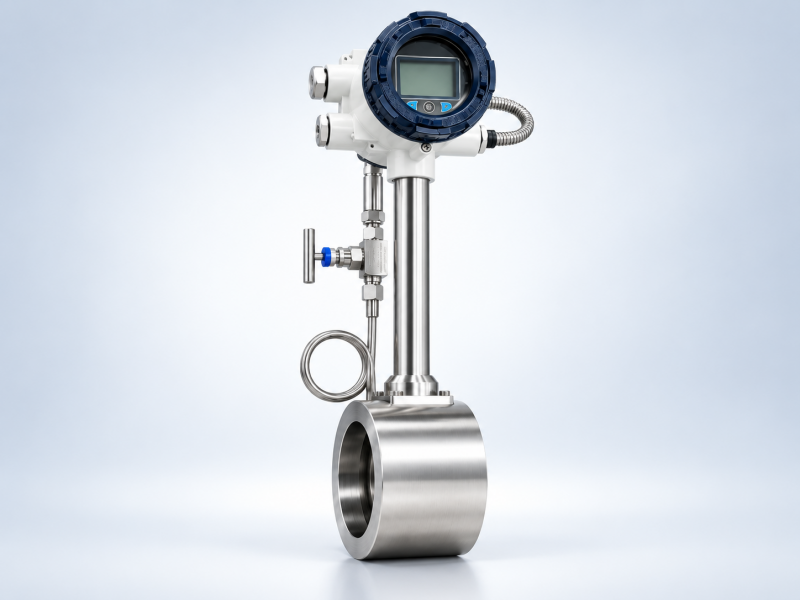
Vortex Flow Meter Brands at a Glance
| Manufacturer | Series or Product Family to Review | Capabilities Worth Reviewing | Key Questions Before Buying |
|---|---|---|---|
| Emerson | Rosemount 8800 | Isolated sensor design, vibration handling, reducer configurations and multivariable options | Does the selected configuration cover the real low-flow range and required process conditions? |
| FlowT | Vortex Flow Meter Series | Steam, gas and liquid measurement, application-based configurations, temperature and pressure compensation options | Which size, configuration and compensation method match the actual operating range? |
| Yokogawa | VY Series | SSP signal processing, diagnostics, maintainability and reduced-bore options | Is the project a new installation or a replacement for an older digitalYEWFLO meter? |
| Endress+Hauser | Proline Prowirl F 200 | Steam-focused functions, pressure and temperature options, wet-steam capability and verification | Which variables are measured directly and which are calculated? |
| KROHNE | OPTISWIRL 4200 / 5080 | Utility measurement, integrated P/T options and high-temperature variants | Does the process require a standard utility configuration or a high-temperature design? |
| Siemens | SITRANS FX330 | Integrated measurement functions, reduced-bore options and automation integration | Do the communication protocol, compensation functions and approvals fit the plant architecture? |
This table should be used as a starting point, not as a substitute for datasheet review. Capabilities can vary by meter size, transmitter version, sensor configuration and operating condition.
What Should You Compare Before Choosing a Brand?
Define the Fluid and the Measurement Objective
Begin with the process rather than the catalog. Is the meter measuring water, another clean liquid, compressed gas, saturated steam or superheated steam? Then define what the plant actually wants to know.
A requirement for volumetric flow is different from a requirement for mass flow, normalized gas volume or steam energy. The distinction between mass flow and volume flow becomes especially important with gases and steam because density changes with process conditions.
If compensated steam or gas measurement is required, determine whether temperature and pressure are measured inside the instrument, supplied by separate devices or entered as fixed values. Where an external pressure measurement is part of the design, a suitable pressure transmitter should be included in the measurement architecture from the beginning.
Check Minimum, Normal and Maximum Flow
One of the most common vortex meter selection mistakes is choosing the meter directly from the nominal pipe diameter.
A vortex meter needs a sufficiently stable vortex signal. At low velocity and low Reynolds number, the signal can weaken until the meter can no longer maintain its specified performance. The practical lower limit depends on the fluid, density, viscosity, meter size and individual manufacturer design.
That is why a quotation request should always include minimum, normal and maximum flow rather than maximum flow alone.
Consider a large steam line that was designed for future capacity but normally operates at a fraction of that load. A full-bore meter may physically fit the pipe while spending too much time near its lower operating limit. A reduced-bore or smaller meter may improve velocity and usable range, but the engineer must then check pressure loss.
There is no universal minimum velocity that applies to every vortex meter. Use the selected manufacturer's sizing data and operating limits rather than applying one number to every brand.
Determine Whether Pressure and Temperature Compensation Are Needed
For many liquids, volumetric measurement may be sufficient. Steam and compressible gases are different because density can change significantly with pressure and temperature.
If the objective is mass flow or energy measurement, verify exactly how compensation is performed. A product described as "multivariable" may integrate temperature, pressure or both, while another configuration may depend on an external value.
This distinction matters commercially as well as technically. A meter that appears more expensive may eliminate separate temperature sensors, pressure transmitters or additional calculation equipment. Conversely, an integrated function that the plant does not need simply adds cost.
Review Installation Conditions and Vibration
Vortex meters detect an oscillating signal generated by vortex shedding. Mechanical vibration and distorted flow profiles can therefore affect measurement quality.
Upstream elbows, partially open valves, pumps, reducers and control valves should all be considered. Straight-run requirements are not identical for every model or disturbance, so the final requirement must come from the selected manufacturer's installation instructions.
FlowT's article on correct vortex flowmeter installation provides a useful general reference before model-specific engineering begins.
Compare Diagnostics, Communication and Maintenance
For a simple plant utility point, 4–20 mA and HART may be enough. Larger projects may require fieldbus communication, remote diagnostics, verification functions, asset-management integration or specific safety approvals.
Do not select advanced diagnostics simply because they appear on a feature list. Ask whether the plant can use them, how technicians will access them and whether the necessary engineering tools are already available.
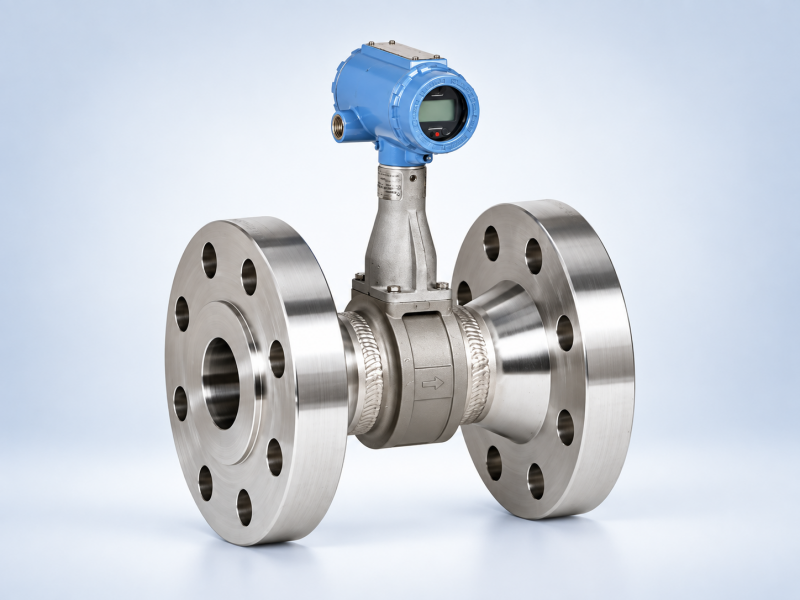
1. Emerson Rosemount 8800
Emerson's Rosemount 8800 family is an established vortex platform for liquid, gas and steam service. The current Rosemount 8800 product information highlights a gasket-free meter body, an isolated sensor design and vibration-focused signal processing.
The isolated sensor concept is particularly relevant where process availability matters because certain sensor maintenance activities can be performed without breaking the process seal. Emerson also offers reducer configurations, which can be useful when the existing pipe is larger than the optimal meter bore for the actual flow.
The important purchasing question is not whether the 8800 has a good reputation. It is whether the selected 8800 configuration covers the real minimum and normal flow, temperature, pressure, communication and approval requirements of the application.
2. FlowT Vortex Flow Meter
FlowT supplies vortex flow meters for industrial steam, gas and liquid measurement and offers different configurations for different flow ranges and process conditions. For buyers comparing suppliers, one of FlowT's useful strengths is the ability to approach selection from the operating conditions rather than treating nominal pipe size as the only starting point.
This is particularly important in steam measurement. A vortex steam flow meter may be used for saturated steam, superheated steam, plant utility monitoring or energy-related measurement, but those applications do not necessarily require the same configuration.
Before selecting a FlowT meter, buyers should provide the actual minimum, normal and maximum flow, operating pressure, temperature, pipe size and required output. Where density changes significantly, the application should also be reviewed for pressure and temperature compensation.
FlowT also provides dedicated configurations for more demanding conditions. For example, buyers working with elevated process temperatures can review the company's high-temperature vortex flow meter options rather than assuming a standard meter body and transmitter arrangement will fit every steam line.
For OEMs, distributors and industrial buyers, this application-first approach is often more useful than comparing one headline accuracy value. The objective should be to confirm whether the proposed meter remains inside its specified operating envelope during normal plant operation, not just at maximum design flow.
3. Yokogawa VY Series
For current project selection, Yokogawa's VY Series is the product family to review. This matters because many older online comparison articles still focus on digitalYEWFLO even though Yokogawa has introduced the VY Series as its successor.
The VY platform continues Yokogawa's Spectral Signal Processing approach, which is designed to separate useful vortex signals from vibration-related noise. The series also emphasizes diagnostics and maintainability.
When replacing an existing digitalYEWFLO meter, do not assume the new device is simply a drop-in replacement. Check dimensions, process connections, communication and existing configuration requirements. New-project selection and installed-base replacement are different engineering tasks.
4. Endress+Hauser Proline Prowirl F 200
Endress+Hauser positions the Proline Prowirl F 200 strongly toward steam and multivariable applications. Depending on configuration, the platform can incorporate temperature and pressure information and calculate additional process variables.
The Prowirl family is also associated with Endress+Hauser's Heartbeat Technology for device verification, while specified configurations include wet-steam-related capabilities.
For engineers, the key is to confirm which of those functions are available in the selected size and version. A family-level feature should not automatically be assumed to exist in every configuration.
This is particularly important in steam systems. The application may require mass flow, energy calculation, saturated-steam compensation or simply a stable volumetric indication. Those are different requirements and should be defined before quotations are compared.
5. KROHNE OPTISWIRL
KROHNE's vortex portfolio illustrates why comparing an entire manufacturer with a single label can be misleading.
The OPTISWIRL 4200 is positioned for utility and energy-management applications. Depending on configuration, temperature and pressure information can be used to calculate additional variables for gas and steam service.
For more severe temperature conditions, the OPTISWIRL 5080 provides a separate path for high-temperature liquid, gas and steam applications.
This makes process temperature an important early filter when considering KROHNE. A utility steam meter and a high-temperature process meter should not be treated as interchangeable simply because both use the vortex principle.
6. Siemens SITRANS FX330
The Siemens SITRANS FX330 is designed for liquid, gas and steam applications and is particularly relevant where process measurement must fit into a broader automation environment.
Available functions include temperature-related measurement, compensation options and industrial communication depending on configuration. This can make the FX330 worth evaluating in plants already using Siemens engineering and asset-management infrastructure.
However, "the PLC is Siemens" is not enough reason to choose the meter. Engineers should still confirm the actual communication protocol, device files, pressure and temperature requirements, flow range, approvals and service strategy.
How the Six Brands Should Be Compared
| Selection Factor | What to Compare | Why It Matters |
|---|---|---|
| Low-flow performance | Minimum specified flow, Reynolds limits, reduced-bore options | A meter that is too large can struggle during normal low-load operation |
| Steam measurement | Temperature, pressure, density compensation, energy calculations | Volumetric flow may not be the final variable the plant needs |
| Vibration | Sensor design, filtering, mounting requirements and diagnostics | Mechanical vibration can interfere with vortex detection |
| High temperature | Sensor limit, transmitter arrangement, materials and pressure class | Temperature limits vary considerably between configurations |
| Maintenance | Sensor access, verification, spare parts and local support | Lifecycle cost may matter more than a small difference in purchase price |
| Control integration | HART, fieldbus, software, device files and DCS compatibility | Integration affects commissioning and long-term maintenance |
| Documentation | Calibration certificate, material certificates and approvals | Documentation can be critical for regulated or project-based procurement |
Example: Selecting a Vortex Meter for a Steam Line
Consider an illustrative plant steam line that was sized for future expansion. The pipe can carry a high peak load, but normal production uses only part of that capacity.
Step 1: Define what the plant needs. If the objective is only local flow indication, the measurement architecture may be simple. If the plant wants departmental steam consumption or energy allocation, mass or energy measurement may require compensation.
Step 2: Check the real operating range. Compare minimum, normal and maximum flow against each candidate meter. Do not assume that the meter should automatically match the full pipe diameter.
Step 3: Consider reduced-bore sizing. If normal flow falls too close to the lower limit of a full-bore meter, a smaller bore may provide a stronger signal. Pressure loss must then be checked.
Step 4: Define the steam condition. Saturated and superheated steam require different process information. If wet-steam behavior is important, confirm that the specific meter and size support the required function.
Step 5: Review the installation. Examine upstream valves, bends, reducers, vibration and available straight pipe before finalizing the model.
Step 6: Compare lifecycle requirements. Calibration, verification, sensor maintenance, local spare parts and documentation should be part of the final commercial comparison.
This type of application-based process provides far more value than choosing the brand with the most impressive brochure accuracy.
When a Vortex Flow Meter May Not Be the Right Choice
Brand selection comes after technology selection. If the process does not suit vortex measurement, choosing a premium vortex brand will not solve the underlying problem. FlowT's overview of industrial flow meter types provides a useful starting point when alternative technologies need to be considered.
Very Low Gas Flow
For gas applications dominated by very low flow and a wide operating range, a thermal mass flow meter may deserve comparison. This is particularly relevant for applications such as compressed-air monitoring where direct gas mass-flow measurement is important.
Conductive Liquids
For conductive liquids where low velocity or pressure-loss concerns make vortex technology less attractive, an electromagnetic flow meter may provide a better fit.
Non-Invasive Retrofit Projects
If the main requirement is avoiding pipe cutting or process shutdown, a clamp-on ultrasonic flow meter may be more practical for suitable liquids.
Clean Low-Viscosity Liquids
For some clean liquid applications, a turbine flow meter may also be worth evaluating. The final choice depends on fluid condition, required range, maintenance tolerance and installation.
What Should Be Included in a Vortex Flow Meter RFQ?
A supplier cannot make a reliable selection from a request that only says, "We need a DN100 vortex meter." A useful RFQ should provide enough information to check the actual operating envelope.
Process Information
- Fluid, gas or steam type
- Minimum, normal and maximum flow
- Operating and design pressure
- Operating and design temperature
- Density and viscosity where relevant
- Saturated or superheated steam condition
- Required volumetric, mass, normalized or energy output
Mechanical Information
- Nominal pipe size and inside diameter where required
- Connection type and pressure class
- Pipe orientation
- Available upstream and downstream straight run
- Nearby valves, elbows, pumps or reducers
- Known vibration or pulsation
- Compact or remote transmitter requirement
Electrical and Control Information
- Required 4–20 mA, pulse, HART or fieldbus output
- DCS or PLC platform
- Local display requirements
- Remote diagnostics or verification requirements
Quality and Commercial Information
- Hazardous-area or safety approvals
- Material certificates
- Calibration and traceability requirements
- Documentation requirements
- Spare-parts expectations
- Local support requirements
- Target delivery schedule
If calibration is part of the purchase specification, define the requirement before ordering rather than after delivery. FlowT's explanation of how to calibrate a flow meter provides additional background on calibration and verification considerations.
Common Mistakes When Comparing Vortex Flow Meter Brands
Comparing Accuracy Without Checking the Operating Range
A headline accuracy value only matters when the application operates inside the conditions under which that performance is specified. Minimum and normal flow should be checked before small differences in accuracy are compared.
Automatically Matching Meter Size to Pipe Size
Nominal pipe size is only one selection input. Velocity, Reynolds number, usable range and pressure loss must also be considered.
Assuming Every Multivariable Meter Works the Same Way
Some configurations integrate temperature, some can incorporate pressure, and others depend on external process values. Verify what is measured directly and what is calculated.
Relying on Old Product Comparisons
Industrial instrumentation product families change over time. Yokogawa's transition from digitalYEWFLO to VY is a clear example. Always check the current manufacturer page before specifying a model.
Comparing Purchase Price Instead of Total Installed Cost
A lower instrument price can be offset by external pressure or temperature instruments, reducers, additional wiring, flow computers, commissioning, calibration or higher maintenance requirements. Procurement teams should compare the complete measurement point rather than the transmitter price alone.
Frequently Asked Questions
Which vortex flow meter brand is best for steam?
There is no universal best brand for every steam system. Compare minimum flow, saturated or superheated steam conditions, maximum temperature, pressure and temperature compensation, energy calculation, installation constraints and maintenance requirements before choosing a manufacturer and model.
Where does FlowT fit compared with the larger international brands?
FlowT can be considered when buyers want application-based vortex meter selection for steam, gas and liquid service together with direct supplier support during quotation. The important comparison should still be based on operating range, process conditions, required outputs, documentation and lifecycle requirements rather than brand size alone.
Is Yokogawa digitalYEWFLO still the current series?
For new product selection, Yokogawa directs buyers toward the VY Series as the successor to digitalYEWFLO. Older digitalYEWFLO instruments may remain in installed plants, so replacement projects require separate compatibility checks.
Can a vortex meter measure mass flow?
The vortex sensing principle determines flow velocity and volumetric flow. A multivariable system can calculate mass flow when the necessary density, temperature and pressure information is available. Always confirm how the selected instrument obtains those variables.
Are vortex flow meters affected by vibration?
Yes. Mechanical vibration can interfere with the oscillating signal used for flow measurement. Modern instruments use sensor design, filtering and diagnostics to improve resistance, but correct installation remains important.
Should a vortex meter always have the same diameter as the pipe?
No. In applications where normal flow is too low for a full-bore meter, a reduced-bore or smaller meter may improve usable range. The engineer must also check pressure loss and installation requirements.
What should procurement compare besides the datasheet?
Calibration documentation, certifications, delivery time, spare parts, local support, warranty, lifecycle status, commissioning requirements and total installed cost should all be included in the final comparison.
Final Takeaway
Emerson, FlowT, Yokogawa, Endress+Hauser, KROHNE and Siemens all provide vortex flow measurement solutions worth evaluating, but the purpose of a brand comparison is not to declare one manufacturer universally superior.
The more useful approach is to define the process first: fluid, minimum and maximum flow, pressure, temperature, required measurement variable, installation constraints, communication and maintenance strategy. Once those conditions are clear, engineers and procurement teams can compare current product families on a common technical basis.
FlowT should therefore be evaluated in the same way as any other supplier: by how well the proposed vortex meter matches the actual application. Buyers who provide complete operating conditions rather than only nominal pipe size are far more likely to receive a meaningful configuration and quotation.


