

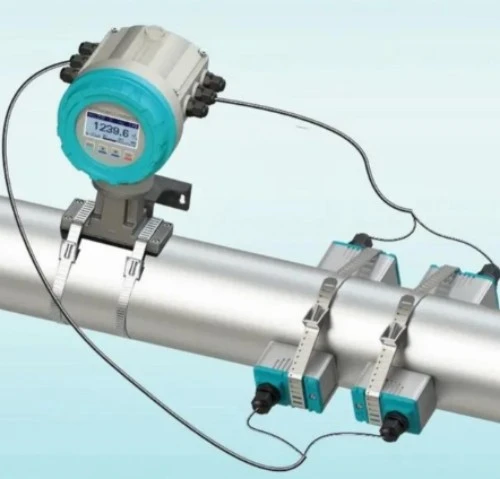
If you've spent any time around gas metering facilities-or even just flipped through technical catalogs-you've probably stumbled across the term "multipath ultrasonic flow meter." Sounds fancy. And honestly, it kind of is.
But here's the thing: the basic concept isn't that complicated once you strip away the jargon.
The Core Idea (Without the Textbook Nonsense)
A multipath ultrasonic flow meter measures gas velocity by shooting ultrasonic signals across a pipe through multiple paths-or "channels," as engineers love to call them. Each channel gives you a velocity reading at a different chord of the pipe cross-section. You average those readings together, weighted appropriately, and boom: you get a decent estimate of how fast the gas is actually moving through that pipe.
Single-channel meters exist too. They're cheaper. They're simpler. But they're also looking at just one slice of the flow profile, which can be misleading if the flow isn't perfectly uniform. And let me tell you-flow is almost never perfectly uniform.
Both single and multipath versions rely on something called the time-of-flight method. It works like this: you have two transducers on opposite sides of the pipe. One sends an ultrasonic pulse downstream (with the flow), the other sends one upstream (against the flow). The downstream pulse arrives faster because it's riding the gas current. The upstream one takes longer because it's fighting it.
You measure both travel times, calculate the difference, and from that difference you can derive the velocity. The math isn't trivial, but it's well-established. People have been doing this for decades.

Why Multiple Channels?
Here's where it gets interesting-and where I have some opinions.
In a multipath meter, V represents the surface average velocity measured on each channel. You're essentially sampling the velocity profile at different heights across the pipe diameter. The formula looks something like this: the volumetric average velocity equals the sum of each channel's velocity multiplied by its weighting coefficient. Written out: v = ΣwᵢVᵢ, where W is the weighting coefficient that depends on whichever integration algorithm the manufacturer decided to use.
From that, you can calculate the actual flow rate: q = A × Σ(WᵢVᵢ), where A is the pipe cross-sectional area.
Different integration schemes assign different weights to different chords. Gaussian quadrature is popular. So is the Chebyshev method. Each has trade-offs. But honestly, unless you're doing the engineering design yourself, you probably don't need to worry about which one is "best." They all work reasonably well.

The Six-Channel Question
Currently, the most common high-end products from foreign manufacturers run up to six channels. You'd think more channels equals more accuracy. And theoretically, yes-more sampling points should give you a better approximation of the true velocity profile.
But practical experience tells a different story.
Once you hit four channels, the accuracy gains from adding more paths become marginal. Meanwhile, manufacturing costs shoot up. Each additional transducer pair needs precise alignment. Each one adds potential failure points. Each one complicates installation and maintenance.
So is a six-channel meter worth it over a four-channel? Sometimes. For custody transfer applications where fractions of a percent matter, maybe. For most industrial applications? Probably not.
Installation Matters More Than You Think
I've seen beautiful six-path meters installed in terrible locations-immediately downstream of elbows, with swirling flow and asymmetric velocity profiles that made all those extra channels almost useless. The meter was measuring garbage, and averaging garbage six different ways just gives you... well-averaged garbage.
General guidance says you want at least eight pipe diameters of straight run upstream and two diameters downstream from any flow disturbance. But that's a guideline, not a guarantee. Cyclonic flow patterns, pitch flow, temperature stratification-all of these can mess with your readings in ways that more channels can't fully compensate for.
Some meter configurations use crossed paths (X-pattern arrangements) to cancel out certain flow distortions. Clever, but not magic.
Real-World Considerations
Reynolds number should be above 4000 for turbulent flow-that's usually not a problem in industrial gas pipelines. Laminar flow is rare. The speed of sound in the gas affects signal travel time, but modern meters handle this automatically through temperature compensation.
Transducers typically mount at angles of 45 degrees or more relative to the flow direction, though the optimal angle depends on pipe diameter, gas velocity, and temperature. Maximum operating temperatures usually cap around 650°F for standard installations. Cryogenic applications are a whole different beast.

The Bottom Line
Multipath ultrasonic flow meters are good technology. They're non-intrusive, have no moving parts, handle a wide range of flow rates, and can achieve impressive accuracy when properly installed and calibrated.
But they're not foolproof. More paths don't automatically mean better results. A well-installed four-channel meter in good flow conditions will outperform a six-channel meter installed in a problematic location every single time.
Understanding the fundamentals-time-of-flight measurement, velocity integration, the role of weighting coefficients-helps you make better decisions about when these meters make sense and how to get the most out of them.


