

A Venturi meter rarely fails on its own. It is one part of a complete differential pressure (DP) measurement system, and an inaccurate or unstable reading usually comes from the pressure taps, impulse lines, transmitter configuration, or process conditions rather than the meter body itself. Knowing where to look first is what separates a thirty-minute fix from a needless meter replacement.
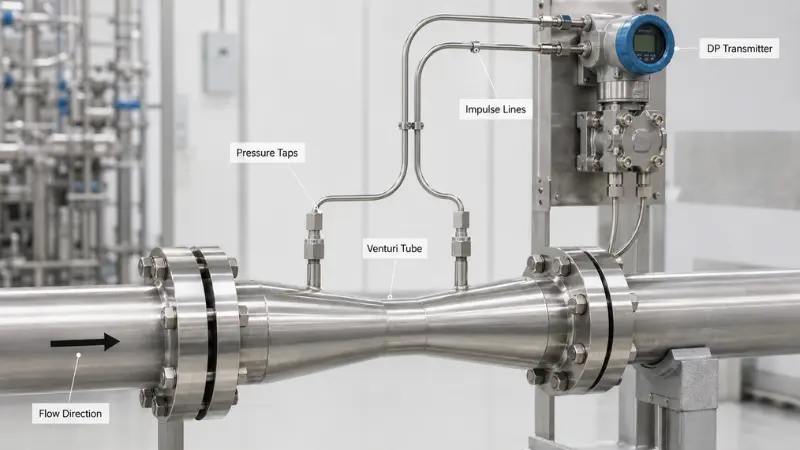
This guide explains the most common Venturi meter problems and solutions in a practical troubleshooting order. It is written for plant engineers, instrumentation technicians, and maintenance teams who need to find the real cause of a flow measurement error before deciding whether to clean, recalibrate, repair, or replace the meter. The framing follows the primary-device approach defined in ISO 5167-1, which treats the Venturi tube and its pressure tappings as the primary device and the transmitter as a secondary device.
Reviewed against ISO 5167 and instrumentation commissioning practice for differential pressure flow measurement.
Quick Answer: What Causes Most Venturi Meter Problems?
Most Venturi meter errors trace back to one of six areas:
- Poor installation or disturbed flow upstream of the meter
- Blocked pressure taps or impulse lines
- Erosion, corrosion, or deposits inside the Venturi tube
- Incorrect differential pressure transmitter setup or scaling
- Non-ideal fluid conditions such as two-phase flow or density change
- Wrong meter sizing or an application mismatch
The single most useful habit when troubleshooting is to stop blaming the meter body by default. A Venturi tube has no moving parts; if it worked correctly at commissioning, a sudden change in reading is far more likely to come from the sensing lines or the transmitter than from the tube geometry.
Venturi Meter Troubleshooting Table
Use this as a first-pass diagnostic before taking the meter out of service. It maps each symptom to the most probable cause and the fastest place to start.
| Symptom | Most Likely Cause | What to Check First | Practical Solution |
|---|---|---|---|
| Reading consistently too high | Wrong DP range, density error, two-phase flow, or throat wear | Transmitter range and units, process density, fluid phase | Correct transmitter scaling, add compensation, inspect throat |
| Reading consistently too low | Blocked high-pressure tap, flow below range, deposits in throat | High-pressure tap and impulse line, actual flow vs range | Flush the line, verify sizing, clean the meter |
| Reading unstable or noisy | Trapped gas or liquid in impulse lines, pulsation, swirl from upstream fittings | Impulse line routing and slope, upstream disturbance | Vent or drain lines, improve installation, apply damping carefully |
| DP signal zero or near zero | Blocked tap, equalizing valve open, no flow, wrong manifold position | Three- or five-valve manifold, taps, actual process flow | Restore correct valve sequence, clear blockage, confirm flow |
| Worked before, accuracy now degraded | Erosion, corrosion, fouling, or transmitter drift | Calibration records, internal surfaces at next shutdown | Recalibrate, clean, or replace damaged components |
| New installation reads wrong | Insufficient straight run, wrong orientation, poor tap layout | As-built pipework vs drawing, upstream fittings, tap position | Rework layout, add flow conditioning, correct impulse routing |
How a Venturi Meter Measurement System Goes Wrong?
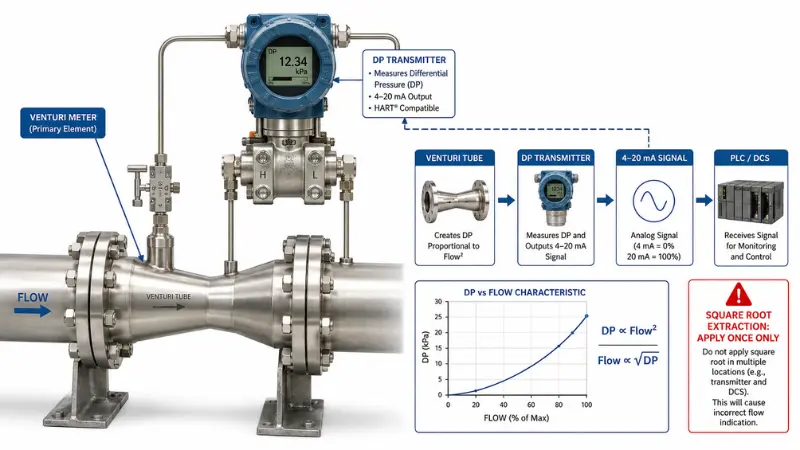
A Venturi meter measures flow by creating a controlled pressure difference between the inlet and the throat. The flow rate is not proportional to that pressure difference directly; it is proportional to its square root. This single fact explains a large share of confusing readings, because the square-root relationship has very high gain at low flow, where a tiny change in DP produces a large swing in calculated flow. Square-root extraction must be applied once, and only once, somewhere in the loop.
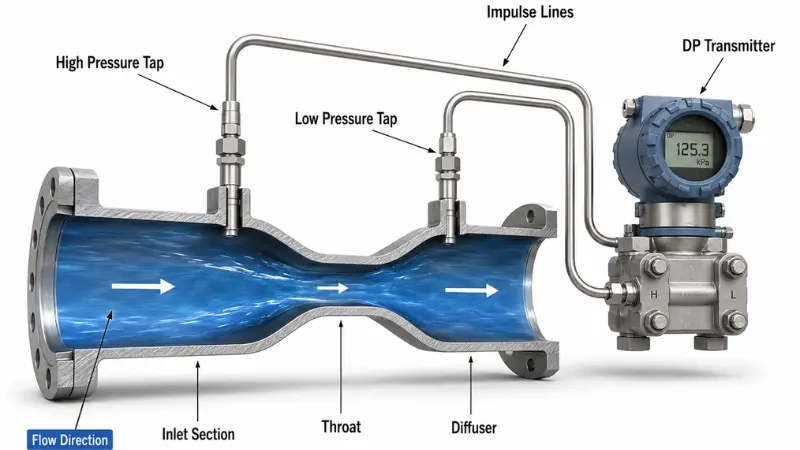
Because the final number depends on several parts working together, troubleshooting should follow the signal path, not start at the tube.
The Venturi Tube
The tube must keep its designed internal geometry. If the throat is worn, pitted, coated, or partially blocked, the relationship between pressure drop and flow changes and the original discharge coefficient no longer applies. ISO 5167 only treats a Venturi tube as valid within defined limits of pipe size, surface roughness, diameter ratio, and Reynolds number, so a tube outside those bounds may read incorrectly even when it looks physically intact.
Pressure Taps and Impulse Lines
The taps and impulse lines carry the high- and low-pressure signals to the transmitter. A small blockage, trapped air, trapped condensate, or a poorly sloped line can create a large error while the main pipeline flow is completely normal. In practice this is the most common real-world fault and the fastest to check.
Differential Pressure Transmitter
The transmitter must be correctly ranged, zeroed, and scaled, with the right engineering units and a single square-root step. A healthy meter will look broken if the transmitter has drifted or if scaling between the transmitter and the control system disagrees.
Process Conditions
Venturi meters perform to specification only when the fluid matches the design basis. Per ISO 5167, the method assumes a single-phase fluid in subsonic, non-pulsating flow. Gas in liquid, liquid in gas, wet steam, slurry, pulsation, or a large density shift will all degrade accuracy regardless of how good the hardware is.
Diagnose Venturi Meter Errors by Reading Pattern
Before opening anything, let the symptom narrow the search. The pattern of the error usually points to a region of the system.
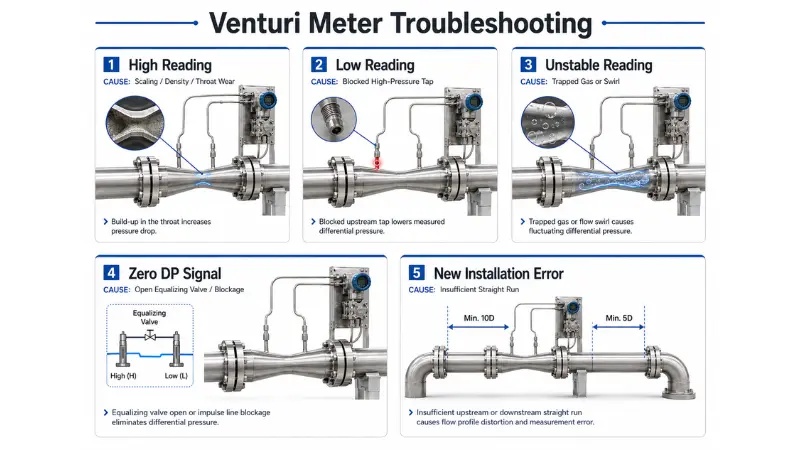
- High reading: suspect scaling or density first - wrong DP range, double square-root extraction, or a density assumption that no longer matches the process. Throat wear can also raise readings but is slower to appear.
- Low reading: suspect the high-pressure side - a blocked high-pressure tap or impulse line lowers the sensed DP and pulls the reading down. Flow that has dropped below the meter's usable range produces the same effect.
- Unstable reading: suspect trapped fluid in the sensing lines or upstream swirl - gas in a liquid leg, condensate in a gas leg, or turbulence from a nearby elbow or valve.
- Zero or near-zero DP: suspect the manifold first - an open equalizing valve is a classic cause - then a fully blocked tap or genuine no-flow.
- Slow response: suspect partial blockage or excessive transmitter damping rather than the tube.
Field note: if venting the high-pressure impulse line temporarily restores a low or sluggish reading, trapped gas or a partial blockage is the likely cause - check that before condemning the transmitter or the meter body.
Problem 1: Poor Installation and Disturbed Flow
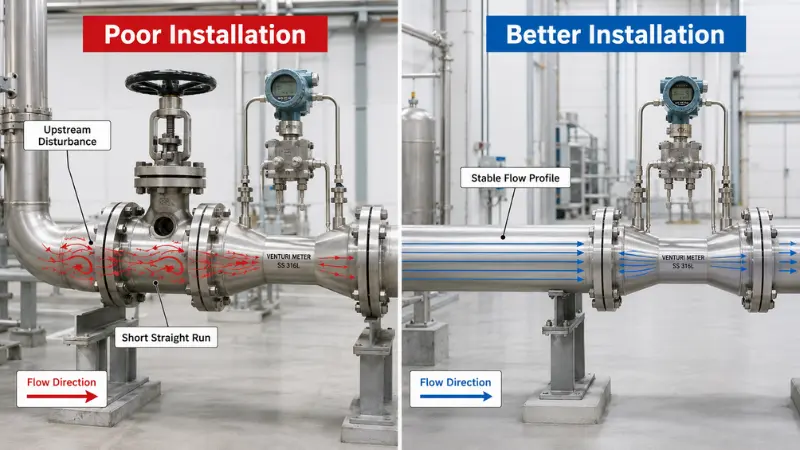
Poor installation is the most common reason a meter reads wrong right after startup. A Venturi meter needs a reasonably developed, swirl-free flow profile at its inlet. Elbows, tees, reducers, pumps, and partially open control valves all generate swirl or asymmetry, and if they sit too close to the meter the sensed pressure drop no longer represents the true flow.
Common Signs
- Inaccurate readings immediately after commissioning
- Instability during otherwise steady flow
- Disagreement with a second meter on the same line
- Poor repeatability at the same operating point
- A reading that shifts when an upstream valve position changes
Straight-Run Requirements
How much straight pipe you need depends on the fitting immediately upstream and on the diameter ratio of the meter. ISO 5167-1 specifies minimum upstream and downstream straight lengths for each combination, and a straight pipe section that is too short is one of the most under-diagnosed installation faults. Two close-coupled elbows in perpendicular planes are especially severe because they generate swirl that a single straight run does not fully remove. Where space genuinely prevents adequate straight pipe, a flow conditioner can be used - but it is a deliberate engineering choice, not a universal patch for every layout problem.
Practical Checks and Solutions
Compare the as-built pipework against the approved drawing; the field rarely matches it exactly. Confirm flow direction, meter orientation, and tap connection. Corrective actions, in rough order of preference, are to increase straight run, relocate the meter away from the worst disturbance, fit a flow conditioner where space is limited, or correct orientation. Do not paper over a bad installation by trimming the transmitter - that hides the error at one operating point and reappears the moment flow changes.
Problem 2: Blocked Pressure Taps or Impulse Lines
Tap and impulse line faults dominate real plant troubleshooting because a tiny obstruction sends the transmitter a wrong signal even when the pipeline is flowing perfectly.

Typical Signs
- DP stuck at or near zero
- Reading far lower than expected
- Jumping or drifting output
- Sluggish response to flow changes
- A clear change immediately after flushing or venting
High-Pressure vs Low-Pressure Side
Which side is blocked changes the symptom, and recognizing this saves time. A restriction on the high-pressure tap lowers the sensed DP and drives the reading down. A restriction on the low-pressure (throat) side can raise the sensed DP and push the reading up or make it erratic. So a steadily low reading points you to the high-pressure leg first; an unexpectedly high or jumpy reading points to the low-pressure leg or to trapped fluid.
Causes and Solutions
Common causes are rust, sand, scale, or process solids in the tap; wax or viscous fluid congealing in the lines; air trapped in liquid service; condensate trapped in gas or steam service; loose fittings; and a manifold valve left in the wrong position. The remedy depends on the service: flush dirty-liquid lines on a planned schedule, vent trapped gas from liquid legs, drain liquid from the low points of gas and steam legs, and add heat tracing where a fluid solidifies at ambient temperature.
Common mistake: good impulse line design is what prevents repeat failures. If the lines cannot be easily isolated, vented, drained, and flushed, the same blockage will return regardless of how carefully you clear it this time. Maintenance guidance for pressure transmitter sensing lines is worth building into the routine plan rather than treating each event as a one-off.
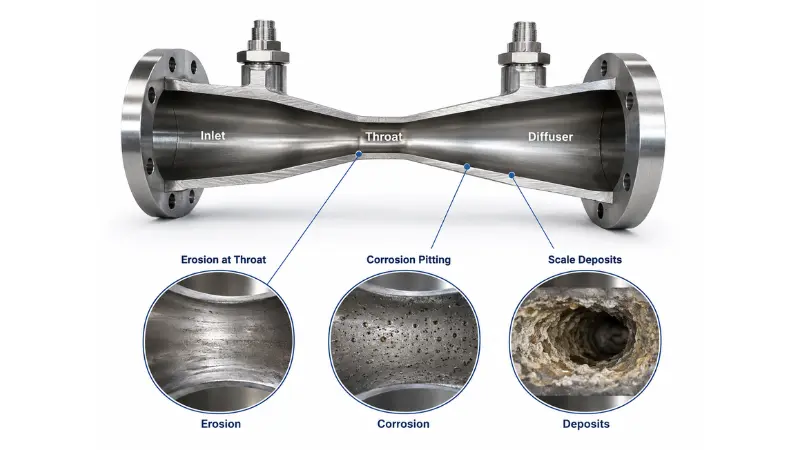
Problem 3: Erosion, Corrosion, or Deposits in the Venturi Tube
The meter relies entirely on its internal shape. When the inlet, throat, or diffuser drift from the original profile, the calibration drifts with them.
Erosion is mechanical wear from sand, catalyst fines, or slurry particles, and it attacks the throat first because velocity is highest there. As the throat opens up, the original discharge coefficient stops being valid. Corrosion is chemical attack - pitting, roughening, and wall thinning that can also become a containment and safety concern, not just a measurement one. Deposits and fouling - scale, biofilm, wax, or sludge - reduce the effective throat area or roughen the surface and shift the reading even when the base metal is undamaged.
Inspection and Solutions
During planned shutdowns, inspect the internal surface where access allows and compare it against design records and earlier inspections. Corrective options include cleaning deposits, replacing damaged tap components, upgrading to a more suitable material, adding a protective lining, or installing upstream filtration or separation. Recalibrate after any repair that touched the wetted geometry, and replace the tube outright once the throat profile can no longer be trusted. For abrasive or corrosive duty, settle the material question before buying a replacement - choosing the right lining and wetted material usually matters more than the meter brand.
Problem 4: Incorrect Transmitter Setup or Calibration
A Venturi tube is paired with a differential pressure transmitter, and a misconfigured transmitter makes a perfect tube look faulty.
Common Transmitter Faults
- Wrong DP range or zero drift
- Incorrect engineering units
- Square-root extraction applied twice, or not at all
- Wrong damping or low-flow cutoff setting
- Incorrect 4–20 mA scaling, or a scaling mismatch with the PLC or DCS
- Manifold valve left equalized
The Square-Root Trap and Low-Flow Cutoff
Because DP is proportional to the square of flow, the square root must be taken exactly once. Take it in the transmitter or in the controller, never both - doing it twice effectively applies a fourth root and corrupts the reading just as badly as omitting it. Configuring the square root in the transmitter is generally preferred, because doing it in the controller leaves the low-flow signal more exposed to electrical noise on the mA loop.
At low flow the square-root curve has very high gain, so small DP noise produces large, erratic flow output. A correctly set low-flow cutoff forces the output to zero below a defined point to suppress this, and as manufacturer guidance on low-flow cutoff notes, there is little value in trusting the signal below roughly 10% of flow. If the cutoff is set wrong, you will see false low-flow indication or unwanted chatter near zero.
Checks and Solutions
Start at the transmitter: confirm range, units, square-root setting, damping, and cutoff, then compare the transmitter's local output against the value shown in the control system. If the local display and the DCS disagree, the fault is in scaling, not in the meter. Reconfigure to the datasheet, perform a zero check under correct valve conditions, verify loop and control-system scaling, and recalibrate or replace a drifted transmitter per plant procedure. Always update the documentation when you change a field setting, or the next technician inherits a meter whose records no longer match reality.
Field example: a newly commissioned line read persistently low. The transmitter, taps, and tube all checked out individually. The actual fault was a square-root function enabled in both the transmitter and the DCS function block - removing it from one side restored correct flow immediately.
Problem 5: Non-Ideal Fluid Conditions
Venturi meters are designed for a defined fluid. When the real process drifts from that basis, errors follow.
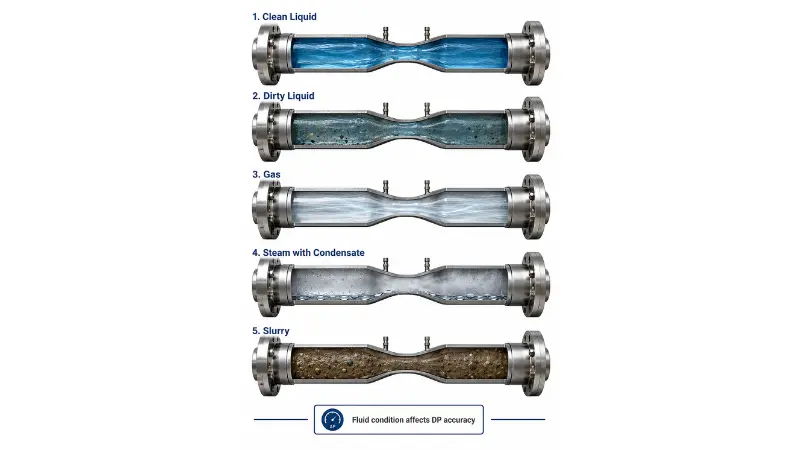
Gas in liquid destabilizes the pressure signal and corrupts the density assumption, especially once bubbles reach the impulse lines. Liquid in gas or wet steam creates a pressure drop that does not match dry-fluid assumptions, and condensate in the legs adds a false static head. Slurry and solids service is possible but demands attention to abrasion and tap blockage. Density, temperature, or pressure shifts change the relationship between DP and mass flow; without live compensation the reading is only correct at the original design point.
Fluid Suitability at a Glance
- Clean liquid: well suited; standard tap and line maintenance.
- Dirty liquid: usable with flushing provisions and tap-blockage awareness.
- Gas: usable; route impulse lines to drain condensate and avoid liquid traps.
- Steam: usable with proper condensate legs kept symmetrical on both sides.
- Slurry: use with caution; expect erosion and elevated maintenance, and reconsider the technology if solids are heavy.
Solutions
Options include adding density, pressure, or temperature compensation; removing or separating the secondary phase upstream; selecting a meter built for dirty or slurry duty; or moving to a different measurement principle when the process is simply too unstable for DP. Compensation only helps when the disturbing variable can actually be measured - if the fluid condition is genuinely unpredictable, a different meter type will be more reliable than any amount of correction.
Problem 6: Wrong Meter Sizing or Application Mismatch
Sometimes nothing is broken - the meter is simply the wrong size or the wrong technology for the duty.
If normal flow runs well below the design flow, the developed DP is too small for stable measurement and the transmitter operates near the noisy bottom of its range. If actual flow exceeds expectations, pressure loss climbs and the transmitter can saturate. On pressure loss specifically, a classical Venturi recovers more pressure than an orifice plate of equivalent duty, which is a real advantage in low-head systems, but the recovery is not total and still costs pumping energy. Material compatibility is the fourth axis: corrosive, abrasive, high-temperature, or sanitary service may demand special construction.
Solutions
Pull the original sizing calculation and compare it against current minimum, normal, and maximum flow, plus real fluid properties, pressure, temperature, and pressure-loss allowance. If operating conditions have shifted since selection, resizing or a different meter is usually more cost-effective than chronic maintenance. When you reach this point, it is worth reassessing the meter selection against the duty rather than forcing the existing meter to fit.
Step-by-Step Field Troubleshooting Workflow
Work this sequence before pulling the meter. Each step rules out a region of the system, so the cheap and likely faults are eliminated before the expensive ones.
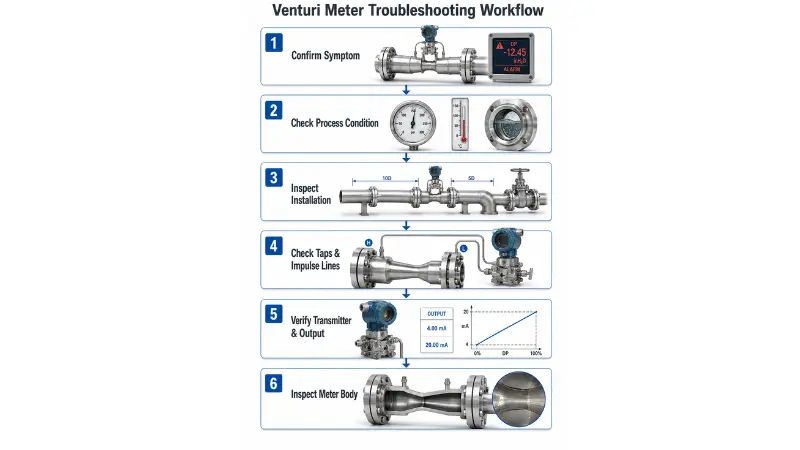
Step 1 - Confirm the Symptom
Define it precisely: high, low, unstable, zero, slow, or disagreeing with another meter. A clear symptom prevents random part-swapping.
Step 2 - Check the Process Condition
Verify actual flow, valve positions, pump status, fluid phase, density, temperature, and pressure. Many "meter faults" are real process changes.
Step 3 - Inspect the Installation
Check layout, upstream disturbance, flow direction, straight run, orientation, and tap connection against the as-built drawing.
Step 4 - Check Taps and Impulse Lines
Look for blockage, leaks, trapped gas or liquid, poor slope, and wrong manifold position. Flush, vent, or drain per procedure - and note which side is affected.
Step 5 - Verify Transmitter and Output
Confirm zero, range, single square-root step, damping, cutoff, and loop scaling, then compare local output against the control system.
Step 6 - Inspect the Meter Body
Only if the above is clean: examine the tube for erosion, corrosion, deposits, or deformation. Changed geometry means recalibration or replacement.
Preventive Maintenance Checklist
A maintenance plan tuned to the service prevents most surprises. Group the tasks by interval rather than treating them as one flat list:
- Routine: compare flow against a process balance or reference instrument; watch for drift, instability, or disagreement with neighboring meters.
- Periodic: confirm transmitter zero; inspect impulse lines for blockage, leakage, and drainage; flush or purge where the service demands it.
- At shutdown: inspect the tube body; review erosion and corrosion risk against fluid condition; confirm manifold valve positions after any work.
- On change: update sizing records and loop scaling whenever process conditions move; keep transmitter settings documented.
Interval is service-specific. Clean water, steam, dirty liquid, slurry, and corrosive chemical duty do not warrant the same frequency, and historical failure records should drive the schedule more than a generic calendar.
Repair, Recalibrate, or Replace? A Decision Path
Match the action to the root cause rather than defaulting to replacement:
- Repair when the fault is external or minor - blocked taps, impulse line issues, loose fittings, or transmitter configuration. This covers the large majority of cases.
- Recalibrate when the wetted geometry has been repaired, the transmitter has drifted, or a verified uncertainty is contractually required. Note that calibration and verification are not the same thing - verification confirms performance against a reference without necessarily adjusting it.
- Replace when the throat profile is damaged beyond trust, corrosion has compromised the body, the meter is genuinely mis-sized, or repeated maintenance no longer restores reliable measurement.
When a Different Meter Is the Better Answer?
A Venturi is not always the right tool. Let the dominant constraint choose the alternative:
- Conductive liquid, low maintenance, full-bore - an electromagnetic flow meter.
- Non-invasive retrofit with no process shutdown - an ultrasonic flow meter.
- Direct mass flow or changing density - a Coriolis mass flow meter.
- Steam, gas, or certain liquids where a DP loss is acceptable - a vortex flow meter.
The final choice still depends on fluid, line size, pressure, temperature, accuracy target, installation space, and budget - a Venturi simply happens to be one valid option among several.
What to Prepare Before Contacting a Supplier?
If you need technical support or a replacement, having the full picture ready turns a long diagnostic exchange into a short one:
- Fluid name, composition, and phase (liquid, gas, steam, slurry, or mixed)
- Pipe size and pipe material
- Minimum, normal, and maximum flow
- Operating pressure and temperature
- Required accuracy and available straight-pipe length
- Existing meter model, drawings, and tap/transmitter arrangement
- Output requirement - 4–20 mA, pulse, HART, or Modbus
- Installation photos where available
Complete process data lets a supplier judge quickly whether the issue is maintenance, installation, or selection. You can share these details directly through the technical contact page.
Frequently Asked Questions
What causes a Venturi meter to read too high?
Usually transmitter scaling or density, not the tube - a wrong DP range, density compensation that no longer matches the process, two-phase flow, or square-root extraction applied twice. Throat wear can also raise readings over time. Check transmitter configuration and process conditions before suspecting the body.
What causes a Venturi meter to read too low?
Most often a blocked high-pressure tap or impulse line, which lowers the sensed DP and pulls the reading down. Flow that has fallen below the meter's usable range, deposits in the throat, or transmitter misconfiguration produce the same effect. The high-pressure sensing leg is the fastest place to start.
How do I calibrate a Venturi meter, and how often?
In practice you verify and calibrate the transmitter and loop against a reference; the tube itself is a primary device whose coefficient is fixed by geometry per ISO 5167. There is no universal interval - fluid cleanliness, corrosion and solids load, temperature, process criticality, and failure history set the frequency. Dirty, corrosive, or high-value duties need more frequent checks than clean water.
Can a Venturi meter measure dirty water or slurry?
Yes for many dirty-liquid and lighter slurry duties, provided you plan for abrasion, deposits, and tap blockage. Material selection, tap design, and easy maintenance access matter most. For heavy slurry, an electromagnetic meter is often the better long-term choice because it has no obstruction to erode.
Venturi meter vs orifice plate - what is the difference?
Both are differential pressure primary devices governed by ISO 5167. A Venturi develops a smoother contraction, recovers far more pressure, and resists wear better, which suits abrasive fluids and low-head systems. An orifice plate is cheaper, simpler, and easier to replace but causes higher permanent pressure loss and erodes faster. The choice trades capital cost against operating cost and durability.
Should square-root extraction be done in the transmitter or the DCS?
In one place only. Configuring it in the transmitter is generally preferred because it keeps the low-flow signal less vulnerable to mA-loop noise. The critical rule is never to enable it in both the transmitter and the control system, which would apply a fourth root and badly distort the reading.
Is the Venturi tube always the problem when readings are inaccurate?
No - and assuming so wastes time. Most errors come from installation, taps, impulse lines, transmitter configuration, or control-system scaling. Inspect the body, but make it the last step, not the first.
Conclusion
Venturi meter problems almost always originate in installation, pressure sensing, transmitter setup, wear, fluid condition, or selection - and rarely in the tube acting alone. The reliable way to solve them is to troubleshoot the whole DP system in order: confirm the symptom, verify the process, inspect the installation, check the taps and impulse lines, confirm the transmitter, and only then open the meter body.
When the cause turns out to be sizing or an application mismatch, no amount of cleaning or recalibration will hold. In those cases a correctly sized meter or a different measurement technology is the better long-term decision. With pipe size, fluid data, flow range, pressure, temperature, drawings, and photos in hand, a supplier can tell you quickly whether the right next step is cleaning, recalibration, repair, replacement, or re-selection.


