

A flow meter symbol on a P&ID tells you where flow is measured, indicated, transmitted, or controlled in a process line. On the drawing it may look like a plain circle, a restriction in the pipe, or a small meter shape. In practice, that mark carries a surprising amount of information about the measurement point, the instrument function, and the design intent behind the loop.

If you are opening a piping and instrumentation diagram for the first time, flow symbols can feel confusing because the drawing usually shows several related items at once: a primary flow element, a transmitter, a local indicator, a controller, and the signal lines that tie them to a control system. This guide walks through how to read those symbols the way an instrument or process engineer reads them during P&ID review, so you can interpret a flow measurement point without guessing. Throughout, one rule holds: the project legend, the instrument datasheet, and the applicable standard always have the final say.
What Is a Flow Meter Symbol on a P&ID?
A flow meter symbol is the graphical representation of a flow measurement device or flow measurement function on a P&ID. Depending on the project standard and the tag, the same kind of symbol may stand for a complete flow meter, a primary flow element, a transmitter, a local indicator, or a flow control function.
That is exactly why a symbol should never be read on its own. Read it together with the letters inside or beside the instrument bubble, the loop number, the process line it sits on, the signal line connected to it, and the project P&ID legend. A circle marked FT usually points to a flow transmitter; a circle marked FI usually means flow indication; a tag such as FIC-101 normally refers to a flow indicating controller in loop 101. The drawing style varies, but the logic is constant: the letters describe the function, while the shape and location tell you how the instrument fits into the process.
Flow Meter Symbol vs Tag vs Instrument Bubble: What Each Part Means
Most reading errors come from blurring three different things that sit on top of each other at one measurement point. Separating them makes everything else easier.
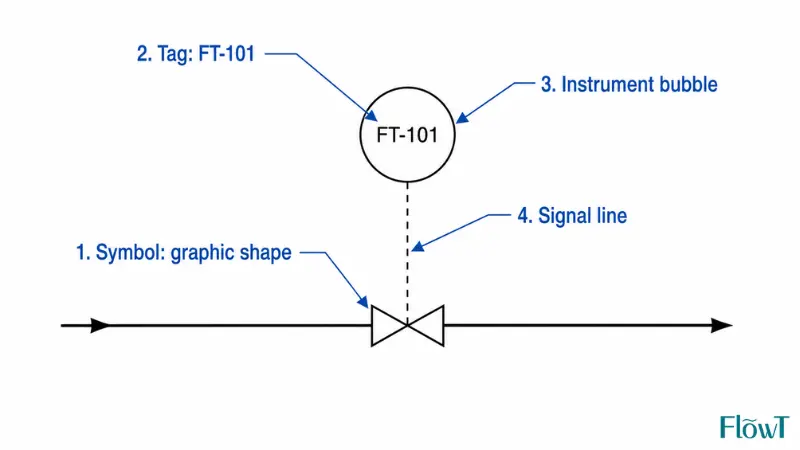
- The symbol is the graphic shape on or beside the pipe - an instrument bubble, a restriction, a tapered tube, or a meter body. It hints at what kind of device or function is there.
- The tag is the text: identification letters plus a loop number, such as FT-101. The letters tell you the function; the number ties the instrument to a specific loop.
- The instrument bubble is the circle (or circle-in-a-square) that houses the tag. Its shape and the line through it encode where the instrument lives - in the field, on a panel, or in a shared display system.
- The line type connected to the bubble is the signal: process connection, electrical signal, pneumatic signal, or a digital data link.
So a single flow point can be described by four layers at once. A common reading mistake is not the symbol itself, but treating the tag letters as decorative text. The letters are usually the most reliable clue on the whole drawing.
How to Read Flow Meter Tags: F, FE, FI, FT, FIC and More
The fastest way to decode a flow symbol is to read the tag letters first. In most P&ID conventions the first letter identifies the measured variable, and the following letters describe the instrument function.

What Does "F" Mean?
In flow instrument tags, F means flow. It signals that the instrument measures, indicates, transmits, switches, records, totalizes, or controls flow.
| Tag | Typical Meaning | What It Tells You |
|---|---|---|
| FE | Flow Element | The primary sensing element that interacts with the fluid |
| FI | Flow Indicator | A device or display that shows the flow rate |
| FT | Flow Transmitter | A device that converts the measurement into a usable flow signal |
| FIC | Flow Indicating Controller | A controller that both displays and controls flow |
| FQ / FQI | Flow Quantity / Totalizer | Integrates flow over time to give a total volume |
| FS | Flow Switch | Changes state when flow crosses a set condition |
| FV | Flow Valve | The final control element driven by the loop |
When the tag carries a totalizing function such as FQ, the point is doing more than reading instantaneous rate - it is accumulating volume for batching, billing, or material balance. That is the same job handled by a dedicated flow totalizer in the field.
Indicator vs Transmitter vs Controller
These three are easy to confuse and very different in function:
- A flow indicator displays the value. It may be mounted locally at the pipeline or shown on a panel or control-system screen.
- A flow transmitter sends a signal. It converts the measured flow into an electrical, digital, or pneumatic output a PLC, DCS, recorder, or controller can use. If you want the detail on what a flow transmitter actually does, it is worth reading separately, because most modern meters on a P&ID are drawn as transmitters.
- A flow controller compares the measured flow against a set point and drives a final control element - usually a valve - to hold the target.
- A flow element is the part that physically senses or creates the measurable condition: an orifice plate, a Venturi tube, a turbine rotor, a magnetic tube, or an ultrasonic transducer arrangement.
What the Loop Number Tells You
The number after the letters identifies the loop. If FE-101, FT-101, and FIC-101 all appear in the same area, they almost certainly belong to one measurement-and-control loop. This is the single most useful habit on a busy drawing: in many plant P&IDs, FE-101 and FT-101 are not two separate flow meters - they are two functions in the same flow loop, traced from the pipe all the way to the control system.
Common P&ID Instrument Bubble Styles for Flow Instruments
The bubble around the tag is not just a container. Under the widely used ISA convention, its shape and the line through it tell you where the instrument is located and whether an operator can reach it.

- Plain circle, no line: a discrete instrument, field mounted and normally accessible to the operator - for example, a local FI at the pipe.
- Circle with a solid horizontal line: located in a primary location such as a central control room, accessible to the operator at the front of the panel.
- Circle with a dashed horizontal line: located behind a panel or in a position not normally accessible.
- Circle inside a square: a shared display / shared control function, typically a DCS, PLC, or SCADA system rather than a single stand-alone device.
This is why local versus remote indication can be read straight from the drawing once you know the convention. The same FT tag can appear as a field bubble and again as a shared-display bubble, showing that the field signal is brought into the control system. As always, confirm these styles against the legend, because companies adapt them.
Common Flow Meter Symbols and What They Mean
Different flow meter types are drawn with different symbols, but styles vary by company, software, country, and project. Read the meter type as a strong hint, not a guarantee, and confirm it before any design, installation, or purchasing decision.
General Flow Meter Symbol
A basic flow meter symbol is often a plain instrument bubble or a simple meter mark on the pipe. It appears when the exact meter type is not yet specified, or when the drawing only needs to show that flow is measured at that point. The nearby tag - FI, FT, or FQ - carries more weight than the shape, because it tells you whether the point indicates, transmits, totalizes, or controls. On a drawing, look for the tag and the connected signal line before assuming anything about the technology.
Orifice Plate Flow Meter Symbol
An orifice plate is a differential-pressure device. On a P&ID it usually shows up as a restriction or plate in the line, with pressure connections running to a differential pressure transmitter. On a drawing, look for upstream and downstream pressure taps, impulse lines, isolation or bypass valves, and a related FT or FIC tag.
The plate and the transmitter are not the same device: the plate creates the pressure difference, and the differential pressure transmitter converts that difference into a flow signal. Orifice-based measurement is common on steam headers, large lines, and gas service, and the geometry and uncertainty are governed internationally by the
ISO 5167 series for differential-pressure flow measurement.
Venturi Meter Symbol
A Venturi meter symbol shows a gradual narrowing and widening of the pipe, mirroring the tube's real shape. It is chosen over a plain orifice plate when the process needs differential-pressure measurement with lower permanent pressure loss - a meaningful advantage on large water mains or energy-sensitive service, though it costs more and takes more space. The permanent-pressure-loss difference between primary devices is exactly the kind of figure quantified in ISO 5167. As with the orifice, the symbol shows the primary element, but the measurement loop also includes the pressure connections and the transmitter.
Rotameter or Variable Area Flow Meter Symbol
A rotameter (variable area meter) is drawn with a tapered tube and a float; as flow rises, the float rises and the operator reads a scale. On a P&ID it usually marks a simple local check point rather than a control loop, and the tag is often just FI. Some versions add a transmitter or switch, so still read the tag and notes. Typical service is utility lines, purge lines, cooling-water checks, and low-flow laboratory systems - places where a quick visual reading is enough.
Magnetic Flow Meter Symbol
A magnetic flow meter (magmeter) measures conductive liquids using electromagnetic induction and is common on water, wastewater, chemical, and slurry lines. Its symbol may suggest electrodes or a meter body installed inline, and it is usually drawn as a transmitter because most magmeters output a signal. On a drawing, look for an inline meter body on a liquid line plus an FT tag.
Here a concrete judgment beats a generic rule: for dirty, conductive wastewater, a magnetic flow meter is usually more practical than a turbine meter because it has no rotor in the flow path to foul or wear. Two installation details matter enough to check on site - confirm
proper grounding and liner material - and remember magmeters do not work on gases, steam, or non-conductive oils.
Turbine Flow Meter Symbol
A turbine flow meter uses a rotor that spins with the flow; rotor speed becomes the flow signal. On a P&ID the symbol often includes a rotor or turbine-style mark in the body, and the device is associated with clean liquids or gases. On a drawing, look for a meter body on a relatively clean line with adequate straight run.
Because a turbine flow meter has moving parts, the practical questions are fluid cleanliness, bearing wear, and viscosity. High or changing
fluid viscosity shifts the calibration, so a turbine is a strong fit for clean, low-viscosity fuels and hydrocarbons and a poor one for dirty or viscous service.
Ultrasonic and Coriolis Flow Meter Symbols
Modern P&IDs increasingly show ultrasonic and Coriolis meters. An ultrasonic flow meter may be drawn with a meter body or an external transducer arrangement, and can be clamp-on or inline - which makes it a frequent choice for retrofits and large pipes where cutting in a meter is impractical. Like most flow meters, it still needs sufficient
upstream and downstream straight pipe runs to read accurately.
A Coriolis meter is drawn with a specialized body and is used where mass flow, density, or high accuracy is required - chemical dosing, custody transfer, and material balance. Because the underlying principle differs from volumetric meters, the tag, equipment note, instrument index, and datasheet usually have to confirm the technology; the basics of Coriolis mass flow measurement are worth understanding before reading these loops.
Two more types fill out common service: for steam and many gas lines you will often see a vortex flow meter, and for compressed air and gas flow a
thermal mass flow meter is typical. The symbol may look generic, so let the line contents and tag steer you.
Flow Meter Symbol Quick Reference Chart
Use this chart as a practical reading aid at the drawing - what the symbol tends to look like, the tags you will see, and what to verify before trusting it.
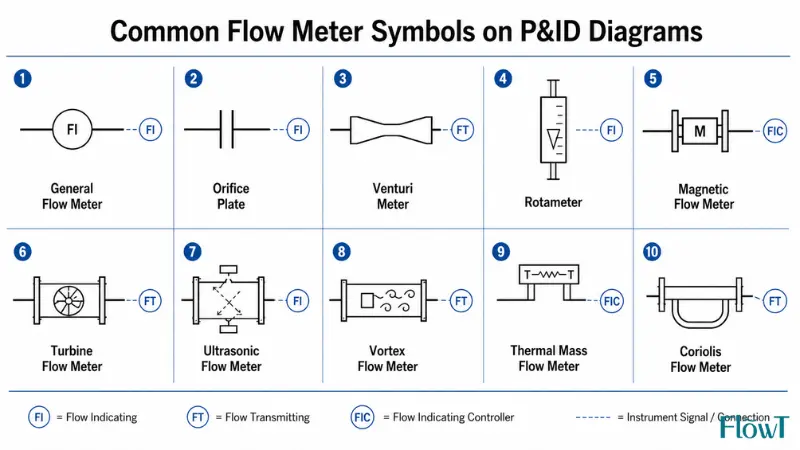
| Flow Meter Type | Common P&ID Clue | Typical Tag | What to Check |
|---|---|---|---|
| General flow meter | Simple meter symbol or instrument bubble on a pipe | FI, FT, FQ | Whether the type is specified elsewhere |
| Orifice plate | Restriction in the pipe with pressure taps | FE, FT, FIC | DP transmitter, impulse lines, tap location |
| Venturi meter | Smooth narrow-and-wide tube shape | FE, FT | Permanent pressure loss, pipe size, space |
| Rotameter (variable area) | Tapered tube with a float, local mount | FI | Local only, or does it also output a signal |
| Magnetic flow meter | Inline body on a conductive-liquid line | FT | Conductivity, grounding, liner material |
| Turbine flow meter | Rotor or turbine-style meter mark | FT, FQ | Clean fluid, viscosity, straight run |
| Ultrasonic flow meter | Inline or clamp-on transducer indication | FT | Pipe material, install method, straight run |
| Vortex flow meter | Inline bluff-body meter, often on steam/gas | FT, FQ | Minimum flow, temperature, vibration |
| Thermal mass flow meter | Inline or insertion meter on a gas/air line | FT | Gas composition, low-flow capability |
| Coriolis flow meter | Specialized inline meter body | FT, FQ, density tag | Mass-flow need, pressure drop, vibration |
This chart is based on common P&ID practice. The same physical device can be represented differently between standards and projects, so always confirm against the project legend and the instrument datasheets.
Reading One Flow Loop: FE-101, FT-101, FIC-101 and FV-101

The clearest way to see how symbols, tags, and signal lines work together is to read a complete loop. Suppose the drawing shows four items sharing loop number 101 on the same line:
- FE-101 - the flow element, drawn as a restriction in the pipe (an orifice plate).
- FT-101 - the transmitter, a bubble fed by impulse lines from the plate's pressure taps. It converts the differential pressure into a flow signal.
- FIC-101 - the controller, usually a shared-display bubble in the control system. It compares FT-101's reading to a set point.
- FV-101 - the control valve, the final element. FIC-101 drives it to hold the target flow.
Follow the lines and the story reads cleanly: the plate creates a pressure difference, the transmitter turns it into a signal, the controller decides, and the valve acts. None of these four is "the flow meter" by itself - together they are one flow control loop. Spotting that shared loop number is what turns four separate symbols into a single, understandable function.
How to Interpret a Flow Measurement Point Step by Step?
Work from the drawing shape to the function and then to the process context.
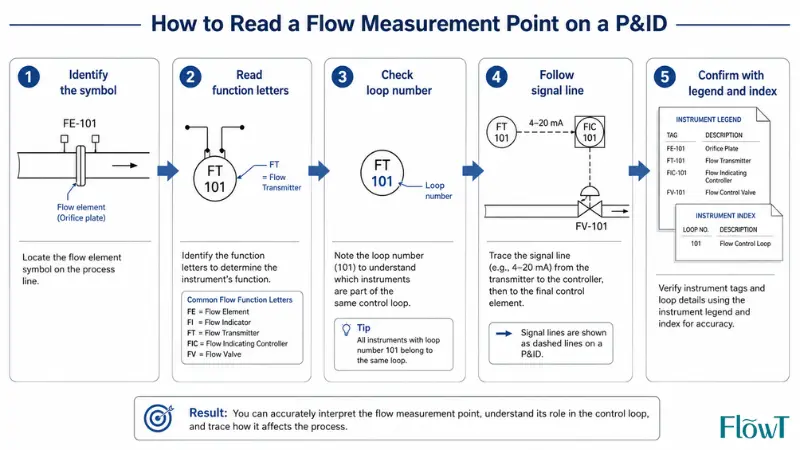
Step 1: Identify the Symbol or Meter Body
Locate the mark on the pipe. Is it a plain circle, a restriction, a tapered element, or a special meter body? This is your first clue to whether the drawing shows a general function or a specific meter type.
Step 2: Read the Function Letters
Read FE, FI, FT, FIC, FS, or FQ. FT transmits a flow signal; FIC indicates and controls; FE refers to the primary element; FQ totalizes. The letters resolve most ambiguity before you look at anything else.
Step 3: Check the Loop Number
Match the numbers. Shared numbers in one area almost always mean one loop, which lets you trace the full measurement-and-control path rather than reading isolated devices.
Step 4: Follow and Decode the Signal Line
The line type tells you how the instrument connects. Conventions vary, but you will commonly encounter a plain solid line for a process or mechanical connection, a dashed line for an electrical signal, a line with double slashes for a pneumatic signal, and a line with small circles or dots for a digital data link. Do not assume a local indicator reaches the control system unless a signal line or tag confirms it - and when a line type is unfamiliar, read it from the drawing legend rather than guessing.
Step 5: Confirm with the Legend and Index
Close the loop by checking the P&ID legend, the instrument index, and the project standard, especially across drawings from different companies, countries, or software. A symbol that looks familiar can still carry a project-specific meaning.
How to Confirm the Actual Meter Type Behind the Symbol
A P&ID symbol shows intent, not a guarantee of what is installed. When the type matters - for sizing, spares, maintenance, or sign-off - follow the document trail rather than the drawing alone:
- P&ID - shows the loop, the function, and the connections.
- Instrument index - lists every tag with its service, type, and references.
- Datasheet - defines the specific meter technology, materials, range, and accuracy.
- Loop diagram - shows wiring, terminations, and signal path device by device.
- I/O list - confirms how the signal lands in the control system.
A simple discipline prevents most field surprises: do not approve a meter type from the P&ID symbol alone; confirm it in the instrument datasheet. If the P&ID only shows a generic FT and no technology, the answer lives in the index and datasheet, not in the shape.
Standards Behind the Symbols: ISA-5.1, ISO 14617 and Project Legends

Symbols vary because more than one standard sits behind them, and projects adapt those standards to their own conventions. Knowing the hierarchy explains most of the variation you will see.
In North America and much of the process industry, instrument tags and symbols follow the ISA-5.1 standard for instrumentation and control symbols and identification, which sets a uniform way to depict and identify measurement and control functions; its 2024 revision was
retitled to emphasize that control symbols are included. Internationally, graphical symbols for diagrams - including the rules for building and presenting them on a P&ID - are covered by
ISO 14617, graphical symbols for diagrams. For differential-pressure devices specifically, the geometry, installation, and uncertainty are defined by ISO 5167.
The practical takeaway is simple: standards explain the grammar, but the project legend governs your drawing. When a familiar symbol and the project legend disagree, follow the legend, then verify against the datasheet.
Common Mistakes When Reading Flow Meter Symbols
Assuming Every Symbol Is Universal
Many symbols follow common conventions, but not every drawing uses the same graphic style. Example: a circle-in-a-square that means "DCS shared display" on one project may be drawn differently on another. Treat the legend as the final reference.
Confusing FE and FT
FE is the element; FT is the transmitter. Example: in an orifice installation, FE-201 is the plate that creates the pressure difference, while FT-201 is the transmitter that turns that difference into a signal. They are one loop, not two meters.
Ignoring the Process Fluid
The symbol shows intent; the fluid decides whether the choice makes sense. Example: a magnetic meter symbol on a non-conductive oil line is a red flag, because a magmeter needs a conductive liquid to work at all.
Missing Local vs Remote Indication
An FI may be a local field reading while an FT sends a signal elsewhere. Example: a plain field bubble at the pipe is not the same as a control-room reading, even when both carry an "FI"-style function. Verify from the bubble style, signal line, and tag.
Reading the Symbol Without the Loop
A flow meter is usually part of a larger loop with a transmitter, controller, valve, alarms, and interlocks. Example: reading only FE-101 while ignoring FIC-101 and FV-101 hides the fact that the point also controls flow, not just measures it.
Choosing the Right Flow Meter Behind the Symbol
If you are not only reading the P&ID but also selecting the meter, the symbol is just the starting point. Turn the usual checklist - fluid type, conductivity, cleanliness, pipe size, accuracy, pressure loss, temperature and pressure, output, maintenance access, and area classification - into a decision rather than a list. The table below shows how those factors point to a type; for a fuller walkthrough, see this guide on choosing a suitable flow meter.

| Application | Often the Practical Choice | Why |
|---|---|---|
| Dirty, conductive water or wastewater | Magnetic flow meter | No moving parts in the flow path; tolerant of solids |
| Clean, low-viscosity fuel or hydrocarbon | Turbine or positive displacement | Good accuracy on clean fluids; sensitive to dirt and viscosity |
| Steam or many gas lines | Vortex (or orifice / DP) | Handles high temperature; no fragile moving parts |
| Compressed air and gas | Thermal mass flow meter | Direct mass-flow reading, strong low-flow performance |
| Large pipes or retrofit, no shutdown | Clamp-on ultrasonic | No pipe cut, no pressure drop, fast install |
| Chemical dosing, custody transfer, mass + density | Coriolis | High accuracy and direct mass measurement |
| Utility, purge, or low-flow local check | Rotameter (variable area) | Simple, low-cost local indication |
For instance, an orifice plate is cost-effective but adds permanent pressure loss; a Venturi reduces that loss but costs more and needs space; a positive displacement meter can be excellent on clean, viscous fluids but tolerates dirt poorly. The best choice depends on the application - and on the datasheet - not on the symbol.
FAQs About Flow Meter Symbols
Q: What does FT mean on a P&ID?
A: FT usually means flow transmitter - a device that sends a flow measurement signal to a control system, recorder, indicator, or controller.
Q: What does FI mean in a flow meter symbol?
A: FI usually means flow indicator. It shows flow to an operator, either locally in the field or on a panel or control screen, depending on the bubble style.
Q: What does FE mean on a P&ID?
A: FE usually means flow element - the primary element that measures or creates the measurable condition, such as an orifice plate, Venturi tube, turbine rotor, or sensing element.
Q: What is the difference between FE and FT?
A: FE is the primary element that interacts with the fluid; FT is the transmitter that converts the measurement into a signal. In an orifice loop the plate is the FE and the differential pressure transmitter is the FT - two functions in one loop.
Q: Is an orifice plate a flow meter?
A: An orifice plate is the primary element of a differential-pressure flow meter, not a complete meter on its own. It needs pressure taps and a transmitter to produce a flow reading, and its design is governed by ISO 5167.
Q: Why do some flow symbols show both FE and FT?
A: Because the element and the transmitter are different functions. The FE interacts with the fluid or creates the measurable condition; the FT turns that condition into a signal.
Q: How do I know which type of flow meter is shown?
A: Read the symbol, the tag letters, and nearby notes, then confirm with the instrument index and datasheet. A generic FT on the P&ID may be defined as a specific technology in another document.
Q: Is a flow meter symbol the same in every P&ID?
A: No. Projects use similar conventions, but the exact symbol varies by company, software, industry, and standard. ISA-5.1 and ISO 14617 set the grammar, but the project legend always wins.
Q: Where can I find the correct P&ID legend?
A: The legend is usually a dedicated sheet at the front of the drawing set, supported by the instrument index and project standards. When in doubt, the legend and datasheet override any general convention.
Key Takeaways
A flow meter symbol is more than a small mark on a P&ID. Read together with its tag, loop number, bubble style, and signal line, it tells you where flow is measured, how the measurement is used, and whether the point is indicated, transmitted, totalized, controlled, or part of a larger loop.
To read flow symbols reliably: never trust the shape alone, read the tag letters, match the loop number, decode the signal line, and confirm meaning against the project legend, instrument index, and datasheet. Once symbols, tags, and process context click into place, even a dense P&ID becomes straightforward - and when you are selecting a meter for a real project, the drawing is the starting point, with the final choice settled by process conditions, accuracy needs, installation constraints, and the control system.


