


When it comes to accurately measuring gas flow rates, thermal mass flow meters have emerged as a reliable solution, especially in laminar flow conditions. As a supplier of thermal mass flow meters, I've had the privilege of witnessing their widespread use across various industries. In this blog post, I'll delve into the measuring accuracy of thermal mass flow meters in laminar flow, exploring the factors that influence it and how our products ensure high - precision measurements.
Understanding Laminar Flow
Laminar flow is a type of fluid flow in which the fluid moves in parallel layers, with little to no mixing between the layers. In this flow regime, the fluid particles follow smooth paths, and the flow is characterized by a low Reynolds number. This type of flow is common in small - diameter pipes, low - velocity applications, and in systems where the fluid has a high viscosity.
The predictability of laminar flow makes it an ideal condition for accurate flow measurement. Unlike turbulent flow, where the fluid motion is chaotic and unpredictable, laminar flow allows for more consistent and stable measurements.
How Thermal Mass Flow Meters Work
Thermal mass flow meters operate on the principle of heat transfer. They typically consist of two temperature sensors: a reference sensor and a heated sensor. The reference sensor measures the temperature of the gas, while the heated sensor is maintained at a constant temperature above the gas temperature.

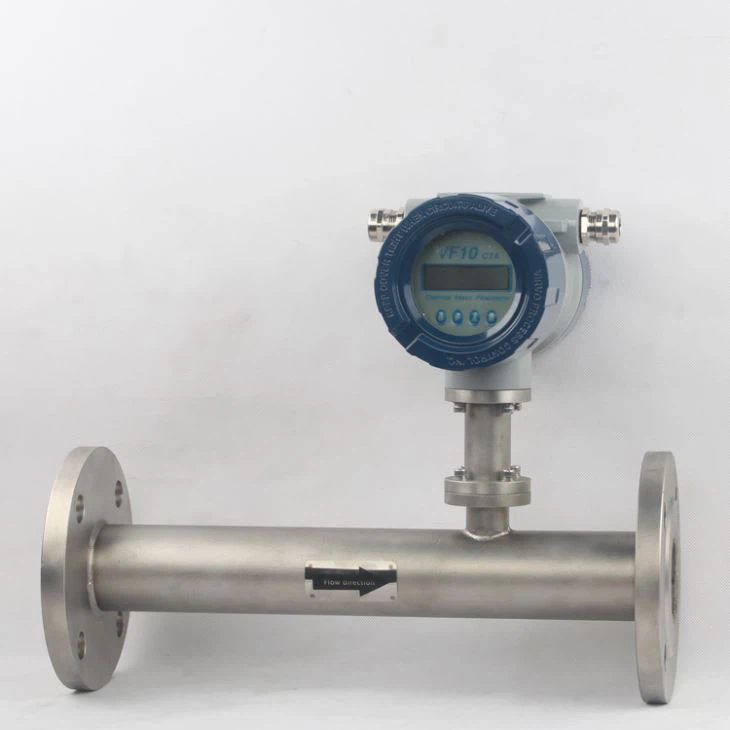
As the gas flows past the heated sensor, it absorbs heat from the sensor. The amount of heat transferred from the heated sensor to the gas is directly proportional to the mass flow rate of the gas. By measuring the power required to maintain the temperature difference between the two sensors, the mass flow rate of the gas can be determined.
Measuring Accuracy in Laminar Flow
The measuring accuracy of a thermal mass flow meter in laminar flow is influenced by several factors.
Sensor Design
The design of the temperature sensors plays a crucial role in determining the accuracy of the flow meter. High - quality sensors with excellent thermal properties can provide more accurate measurements. Our Good Quality Thermal Mass Flow Meter is equipped with state - of - the - art sensors that are carefully calibrated to ensure precise heat transfer measurements. These sensors are designed to be highly sensitive to changes in gas flow, allowing for accurate detection of even small flow rates.
Gas Properties
The properties of the gas being measured, such as its specific heat capacity, thermal conductivity, and viscosity, can affect the accuracy of the flow meter. Different gases have different heat transfer characteristics, and the flow meter must be calibrated for the specific gas being used. Our thermal mass flow meters can be customized to accommodate a wide range of gases, including air, nitrogen, oxygen, and natural gas. By taking into account the unique properties of each gas, we can ensure accurate measurements in laminar flow conditions.
Flow Profile
In laminar flow, the velocity profile of the gas is parabolic, with the highest velocity at the center of the pipe and the lowest velocity near the pipe walls. A uniform flow profile is essential for accurate measurements. Any disturbances in the flow, such as bends, valves, or fittings in the piping system, can cause the flow profile to become non - uniform, leading to measurement errors. Our flow meters are designed to minimize the effects of flow disturbances. They can be installed with flow straighteners or in locations where the flow is relatively undisturbed to ensure a more uniform flow profile and accurate measurements.
Calibration
Proper calibration is essential for ensuring the accuracy of a thermal mass flow meter. Calibration involves comparing the output of the flow meter to a known standard flow rate. Our thermal mass flow meters are calibrated in our state - of - the - art calibration facilities using traceable standards. We also offer on - site calibration services to ensure that the flow meters maintain their accuracy over time.
Advantages of Using Thermal Mass Flow Meters in Laminar Flow
There are several advantages to using thermal mass flow meters in laminar flow applications.
Direct Mass Flow Measurement
Thermal mass flow meters provide a direct measurement of the mass flow rate of the gas, eliminating the need for additional pressure and temperature compensation. This makes them more accurate and reliable than other types of flow meters, such as volumetric flow meters, which require compensation for changes in gas density.
Wide Turndown Ratio
Thermal mass flow meters have a wide turndown ratio, which means they can accurately measure a wide range of flow rates. This makes them suitable for applications where the flow rate may vary significantly over time.
Low Pressure Drop
Thermal mass flow meters have a low pressure drop, which means they do not significantly impede the flow of the gas. This is particularly important in applications where energy efficiency is a concern.
Our Role as a Thermal Flow Meter Supplier
As a Thermal Flow Meter Supplier, we are committed to providing high - quality thermal mass flow meters that offer accurate measurements in laminar flow conditions. Our products are designed and manufactured to meet the highest industry standards, and we offer a comprehensive range of services, including installation, calibration, and maintenance.
We understand that every application is unique, and we work closely with our customers to provide customized solutions that meet their specific needs. Whether you are in the chemical, pharmaceutical, food and beverage, or semiconductor industry, our Gas Mass Flow Meter can provide accurate and reliable flow measurements.
Conclusion
The measuring accuracy of a thermal mass flow meter in laminar flow is influenced by several factors, including sensor design, gas properties, flow profile, and calibration. By carefully considering these factors and using high - quality components, our thermal mass flow meters can provide accurate and reliable measurements in a wide range of laminar flow applications.
If you are in need of a thermal mass flow meter for your laminar flow application, we invite you to contact us for more information. Our team of experts is ready to assist you in selecting the right flow meter for your needs and ensuring its proper installation and operation.
References
- Miller, R. W. (1983). Flow Measurement Engineering Handbook. McGraw - Hill.
- Spitzer, D. W. (2001). Flow Measurement: Practical Guides for Measurement and Control. ISA - The Instrumentation, Systems, and Automation Society.
- Benedict, R. P. (1984). Fundamentals of Temperature, Pressure, and Flow Measurements. Wiley - Interscience.


