

Ultrasonic gas flow sensors, also known as ultrasonic gas flow meters, represent advanced measurement technology for gas media (including natural gas, compressed air, and process gases). These non-invasive devices utilize ultrasonic waves to measure gas flow without physical contact with the fluid medium, providing excellent accuracy and reliability in various industrial applications. This guide explores the working principles, structural design, and practical applications of ultrasonic gas flow sensors.
Working Principle of Ultrasonic Gas Flow Sensor:
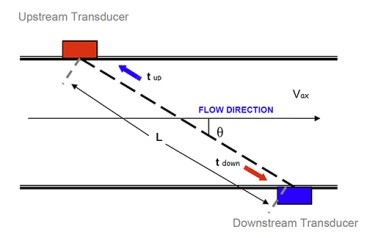
The core of ultrasonic gas flow sensors is the use of sound waves to measure gas velocity. The primary method is the transit-time principle, where ultrasonic transducers (sensors) emit pulses that travel through the gas stream. Two transducers are positioned such that one sends signals downstream (with the flow) and the other sends signals upstream (against the flow). The time difference (Δt) between these paths is proportional to the gas velocity (V), calculated using the following formula:

where L is the path length and t0 is the average transit time. The volumetric flow rate is then calculated by multiplying by the cross-sectional area of the pipe. Another variant is the Doppler effect, where waves reflect off bubbles or particles in the gas, and the frequency shift indicates velocity-ideal for gases containing impurities. Advanced models employ shear waves for direct transmission or Lamb waves, which cause the pipe wall to resonate to amplify signals in low-pressure or attenuating gases. Multi-path configurations (such as 4 or 6 paths) average measurements across the pipe to handle turbulent or asymmetric flows, improving accuracy. This diagram illustrates the transit-time setup, showing how upstream and downstream signals differ based on flow.
Multi-Channel Ultrasonic Gas Flow Sensor Structure
The composition of multi-channel gas ultrasonic flow meters mainly includes four parts: ultrasonic flow meter main body, pressure transmitter, intelligent temperature transmitter, and flow computer. The ultrasonic flow meter is mainly composed of two major components: One is the measurement pipe section equipped with multiple pairs of ultrasonic transducers (also known as the primary instrument); The other is the signal processing unit (SPU) with measurement, instantaneous flow rate display, and communication functions, commonly referred to as the secondary instrument.The following diagram shows the block diagram of a multi-channel ultrasonic
flowmeter.

The secondary instrument can directly connect to the gas pressure and temperature sensors in the pipeline, and through internal signal conversion and compensation calculation, complete the compensation effect of temperature and pressure in the pipeline on the gas volumetric flow rate, independently completing the measurement of volumetric flow rate without relying on the flow computer. In addition, through the intelligent temperature transmitter and pressure transmitter, the digital signals of temperature and pressure in the pipeline can also be transmitted to the flow computer to compensate for the instantaneous flow velocity and volumetric flow rate values measured by the secondary instrument.
The sensor part of the multi-channel gas ultrasonic flow meter mainly refers to the measurement pipeline part, and the structural analysis of the flow sensor mainly refers to the connection of the measurement pipeline and the installation distribution positions of each ultrasonic transducer. The flow measurement pipeline is designed and manufactured with flange end faces, connected in the straight conveying pipeline. In the A.G.A. No. 9 document "Multi-Channel Ultrasonic Flow Meters for Measuring Natural Gas Flow" formulated by the American Gas Association in 1998, research work has already pointed out that asymmetric velocity distribution persists from the point of occurrence up to 50D or downstream, and velocity profiles with vortices may exist at 200D or farther (D is the inner diameter of the measurement pipeline).
Therefore, in general industrial gas flow measurement sites, the installation position of the flow meter must consider the influence of complex flow states on flow velocity measurement. According to the GB/T 18604-2023 standard, the following recommendations are proposed for the installation position of multi-channel gas ultrasonic flow meters: The minimum straight pipe length upstream is 10D, and the minimum straight pipe length downstream is 5D. This recommendation can only be established when the upstream conditions are relatively ideal (such as very small vortex intensity and slightly asymmetric velocity distribution), and should be regarded as the minimum requirement to meet measurement needs. As shown in the figure below, multi-channel gas ultrasonic flow meters need to consider the propagation efficiency of ultrasonic waves, adopting ultrasonic transducers embedded and installed on the measurement pipeline.
The figure below shows a schematic diagram of the channel layout for a multi-channel ultrasonic gas flowmeter sensor, illustrating the ring-shaped pipeline structure measured by a four-channel cross ultrasonic gas flowmeter.

The 4 channels are respectively arranged on different flow layers, and the channels cross each other when viewed in the y direction and are parallel to each other when viewed in the z direction. The measurement pipeline consists of a composite sensor with 4 channels formed by pairs of ultrasonic transducers with an operating frequency of 200~250 kHz. The pipe diameter D = 300 mm, and the angle φ between each channel and the axial direction is 60°.
Application Scenarios of Multi-Channel Ultrasonic Gas Flow Sensor Structure
Multi-channel ultrasonic gas flow sensors are crucial in industries requiring precise gas measurement:
Oil and Gas Industry: Custody transfer, pipeline monitoring, compressor stations, and leak detection in natural gas systems.
Chemical and Petrochemical: Process gas measurement in harsh environments.
Power Generation and Manufacturing: Emissions monitoring, inventory control, and efficiency optimization.
HVAC and Utilities: Compressed air and biogas flow in buildings or wastewater treatment.
FAQ
Q: How often do ultrasonic gas flow sensors need calibration?
A: Ultrasonic gas flow sensors require initial calibration at commissioning, with recalibration typically recommended every 2-5 years depending on application criticality. For custody transfer applications, AGA-9 recommends calibration at seven flow rates: 100%, 75%, 50%, 25%, 10%, 5%, and 2.5% of maximum flow, with each test point averaged over 90-300 seconds. Manufacturing variations and piping installation differences can affect accuracy, making calibration essential for optimal performance. Unlike mechanical meters that drift significantly, ultrasonic meters maintain stable accuracy over time due to having no moving parts, allowing for less frequent recalibration intervals.
Q: What is the initial cost versus long-term total cost of ownership?
A: While initial investment in ultrasonic flow meters may exceed traditional meters, total cost of ownership often proves lower due to reduced maintenance, minimal downtime, and extended service life. A single ultrasonic gas meter can replace two parallel turbine meters (small and main load rails), reducing infrastructure costs. Ultrasonic meters have expensive initial costs but lower setup costs than some alternatives, with minimal maintenance due to no moving parts. The optimized signal detection eliminates expensive noise attenuation infrastructure, and reduced maintenance and repair costs at measuring points offset higher upfront investment. For large-diameter applications, clamp-on versions provide significant installation cost savings.
Q: What routine maintenance is required and how often?
A: Ultrasonic gas flow sensors are designed for low-maintenance operation, with typical maintenance including cleaning the probe face at 1-6 month intervals depending on site conditions, checking purge system and air filters, and occasional recalibration if required. In dusty environments like flue gas applications, automated purge systems using 0.1-0.6 MPa clean instrument air at 3-6 L/min keep sensor faces clean and prevent measurement drift. Sensors can be replaced on-site and under pressure using plug-and-play configuration, and meter operation is not directly affected by impurities on pipe walls.
Q: What are the operating temperature and pressure limits for ultrasonic gas flow sensors?
A: Transducers have been developed to withstand temperatures from -260°F for LNG metering to 500°F for power plant applications. Modern sensors typically handle -40°C to +170°C (-40°F to +338°F) for standard applications, with specialized high-temperature versions capable of 150°C to 550°C (+302°F to +1022°F). Pressure ranges extend from 1 bar to 300 bar (14.5 to 4350 psi), with sensors operating at standard frequencies of 120 or 200 kHz. For low-pressure applications, sound transmission requires minimum gas density, and Lamb wave technology enables measurement down to near-atmospheric pressure.


