

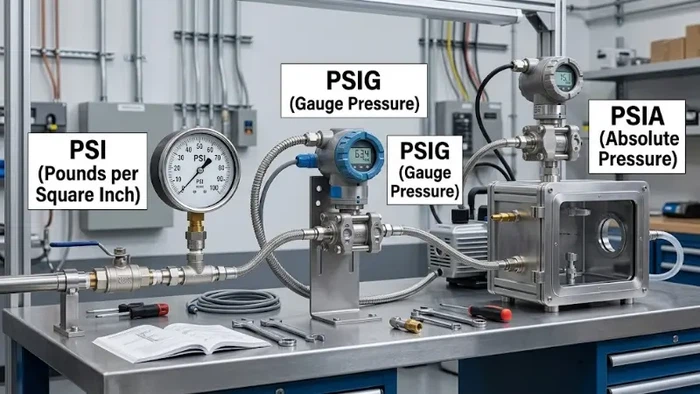
PSI (pounds per square inch) is a general pressure unit. PSIG measures pressure relative to the surrounding atmosphere. PSIA measures pressure relative to a perfect vacuum. The conversion formula is: PSIA = PSIG + Local Atmospheric Pressure. At sea level, 0 PSIG equals approximately 14.696 PSIA - not zero pressure.
What Is PSI?
PSI stands for pounds per square inch. It describes force applied per unit area and is the most widely used pressure unit in the United States and in many industrial applications worldwide. However, PSI alone does not specify a reference point. A pressure reading of 50 PSI could mean 50 PSI above atmospheric pressure (gauge), or 50 PSI above absolute vacuum (absolute). These two interpretations describe very different physical conditions.
Because of this ambiguity, engineering documents, instrument datasheets, and calibration records should never use "PSI" without clarifying whether the value is gauge or absolute. Writing only "PSI" on a purchase order or P&ID has led to incorrect sensor selection, failed calibration, and process upsets in real installations.

What Is PSIG (Pounds per Square Inch Gauge)?
PSIG measures pressure relative to the local atmospheric pressure. A standard mechanical pressure gauge reads 0 PSIG when its sensing element is open to the surrounding air. This does not mean no pressure exists - it means the pressure inside the gauge matches the atmosphere outside.
When a tire pressure gauge reads 32 PSIG, the air inside the tire exerts 32 psi more than the surrounding atmosphere. A compressed air receiver rated at 125 PSIG holds air at 125 psi above atmospheric pressure. In both cases, the actual total pressure on the gas molecules is higher than the PSIG value suggests, because atmospheric pressure still acts on the system.
PSIG is the default pressure reference for most field instruments and plant operations. Pipe pressure, tank pressure, pump discharge, steam line pressure, hydraulic system pressure, and boiler operating pressure are almost always expressed in PSIG. Maintenance technicians, operators, and most equipment nameplates use gauge pressure because the practical concern is how much pressure exceeds the surrounding atmosphere - that difference determines mechanical stress on pipes, vessels, flanges, and fittings.
What Is PSIA (Pounds per Square Inch Absolute)?
PSIA measures pressure relative to a perfect vacuum - the theoretical state of zero molecular activity and zero pressure. On this scale, 0 PSIA represents absolute vacuum, and standard atmospheric pressure at sea level is approximately 14.696 PSIA (often rounded to 14.7 PSIA for practical calculations).
Absolute pressure matters whenever the total pressure of a system affects the outcome - not just the pressure above atmosphere. This is the case in vacuum systems, gas density calculations, thermodynamic equations, and any process where the ideal gas law or other gas behavior models apply. Gas molecules respond to total (absolute) pressure, regardless of what a gauge reads.
PSIA is also the clearer reference in vacuum applications. A vacuum chamber operating at 2 PSIA communicates a specific physical condition. Describing the same state as -12.7 PSIG (approximately) is less intuitive and introduces the risk of sign errors in calculations.
PSI vs PSIA vs PSIG: Comparison Table
| Term | Full Name | Reference Point | What Zero Means | Typical Applications |
|---|---|---|---|---|
| PSI | Pounds per square inch | Not specified | Ambiguous - depends on context | General pressure unit (should be clarified as PSIG or PSIA) |
| PSIG | Pounds per square inch gauge | Local atmospheric pressure | Pressure equals surrounding atmosphere | Pressure gauges, pipes, tanks, compressors, hydraulic systems, steam lines |
| PSIA | Pounds per square inch absolute | Perfect vacuum (zero molecules) | Absolute vacuum - no pressure at all | Vacuum systems, gas law calculations, thermodynamics, altitude-sensitive measurement |
| PSID | Pounds per square inch differential | Difference between two pressure points | No pressure difference between the two points | Filter monitoring, orifice plates, flow measurement across restrictions |
Note on PSID: Industrial users frequently encounter differential pressure (PSID) alongside PSIG and PSIA. A differential pressure transmitter measures the difference between two process pressures - for example, the pressure drop across a filter, orifice plate, or heat exchanger. PSID does not reference atmosphere or vacuum; it only measures the gap between two connected pressure taps.
PSIG to PSIA Conversion Formula
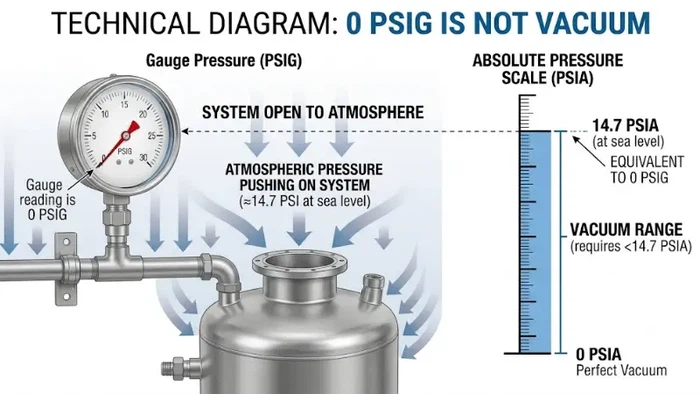
The relationship between gauge and absolute pressure is defined by a straightforward equation established in physics:
PSIA = PSIG + Local Atmospheric Pressure
And the reverse:
PSIG = PSIA − Local Atmospheric Pressure
At sea level, standard atmospheric pressure is 101,325 Pa (14.696 psi), commonly rounded to 14.7 psi for everyday engineering work.
How to Convert PSIG to PSIA (Step by Step)
Step 1: Identify whether the pressure value you have is gauge (PSIG) or absolute (PSIA).
Step 2: Determine your local atmospheric pressure. If you are near sea level, 14.7 psi is a reasonable approximation. At higher elevations - for example, Denver, Colorado at 5,280 feet - average atmospheric pressure is closer to 12.2 psi. For precision work, use an on-site barometer or reference a local weather station.
Step 3: Apply the formula. Add atmospheric pressure to PSIG to get PSIA, or subtract atmospheric pressure from PSIA to get PSIG.
Step 4: Decide whether the 14.7 psi approximation is acceptable for your application or whether you need actual local conditions. For compressed air checks and routine maintenance, the approximation is usually fine. For vacuum calibration, gas density compensation in gas flow meters, or laboratory-grade measurement, use the true local atmospheric value.
Conversion Examples
Example 1 - Convert 100 PSIG to PSIA (sea level):
PSIA = 100 + 14.7 = 114.7 PSIA
Example 2 - Convert 30 PSIA to PSIG (sea level):
PSIG = 30 − 14.7 = 15.3 PSIG
Example 3 - What is 0 PSIG in PSIA?
PSIA = 0 + 14.7 = 14.7 PSIA. This confirms that 0 PSIG is not a vacuum - it simply means pressure is equal to the local atmosphere.
Example 4 - Convert −5 PSIG to PSIA (sea level):
PSIA = −5 + 14.7 = 9.7 PSIA. The system is under partial vacuum. The absolute pressure is 9.7 psi above perfect vacuum.
Example 5 - Convert −10 PSIG to PSIA (sea level):
PSIA = −10 + 14.7 = 4.7 PSIA. This represents a deeper vacuum, and a gauge reading this far below zero is approaching the lower measurable range of many standard gauges.
Example 6 - Convert 100 PSIG to PSIA in Denver, Colorado (elevation ~5,280 ft):
PSIA = 100 + 12.2 = 112.2 PSIA. Note that this is 2.5 psi lower than the sea-level result. For most pipe pressure checks, the difference does not affect the decision. For gas density compensation in a vortex flow meter or a mass flow calculation, that 2.5 psi offset can produce a measurable error in the corrected flow reading.
Why Local Atmospheric Pressure Matters?
The figure 14.7 psi (more precisely 14.696 psi) represents the average atmospheric pressure at mean sea level. Actual atmospheric pressure changes with elevation, weather, and temperature. According to the international standard atmosphere, pressure drops roughly 0.5 psi for every 1,000 feet of elevation gain. At Denver's altitude of 5,280 feet, the average local atmospheric pressure is approximately 12.2 psi - about 17% lower than the sea-level standard.
For routine plant operations at moderate elevations, using 14.7 psi as a default usually creates no practical problem. A compressed air system rated at 125 PSIG operates safely whether the local atmosphere is 14.7 or 12.2 psi, because the gauge reference adjusts automatically.
The 14.7 psi approximation becomes problematic in specific situations: calibrating absolute pressure instruments, performing gas law calculations where density matters, running vacuum systems where the target is expressed in PSIA, and compensating gas mass flow meters that use absolute pressure as an input. In these cases, substituting 14.7 psi for a true local value of 12.2 psi introduces an error of about one-sixth of an atmosphere, which directly affects calculation accuracy.
When to Use PSIG vs PSIA?
Use PSIG for Pressurized Systems Above Atmosphere
PSIG is the right reference when you need to know how much pressure exceeds the surrounding atmosphere. This applies to compressed air systems, water piping, hydraulic lines, steam systems, pressure vessels, and pump discharge - essentially any application where mechanical stress on the containment is the primary concern. The stress on a pipe wall depends on the pressure difference between inside and outside, which is what a gauge measures.
Use PSIA for Vacuum, Gas Laws, and Density-Dependent Processes
PSIA is the right reference when total pressure drives the physical outcome. Gas density is proportional to absolute pressure and inversely proportional to absolute temperature (from the ideal gas law: PV = nRT). If a flow meter or flow computer uses pressure to compensate a volumetric gas reading to standard conditions, it needs absolute pressure. Feeding it a gauge value when it expects absolute - or the reverse - will offset the result by roughly one atmosphere. In a process running at 30 PSIG, that represents about a 33% error in corrected volume flow.
PSIA is also preferred for vacuum distillation, vacuum furnaces, freeze-drying, semiconductor fabrication, and any process where the operating pressure is below atmospheric. Expressing a deep vacuum as "−13 PSIG" is less clear and more error-prone than stating "1.7 PSIA."
Pressure Reference Selection Guide
| Application | Recommended Reference | Reason |
|---|---|---|
| Compressed air receiver | PSIG | Operators need pressure above atmosphere for safety and regulation |
| Vacuum chamber | PSIA | Absolute pressure is clearer near vacuum - avoids negative numbers |
| Gas flow compensation | PSIA | Gas density depends on absolute pressure, not gauge |
| Filter or orifice monitoring | PSID | Pressure drop across the element is the value that matters |
| Steam line monitoring | PSIG | Operating and design pressures are referenced to atmosphere |
| Hydraulic press | PSIG | Force output depends on gauge pressure in the cylinder |
| Barometric measurement | PSIA | Atmospheric pressure itself is an absolute measurement |
| Gas law calculations (PV=nRT) | PSIA | Ideal gas law requires absolute pressure and absolute temperature |
Industrial Applications
Pressure Gauges and Pressure Transmitters
Most mechanical pressure gauges and industrial pressure transmitters measure gauge pressure. They are built with one side of the sensing element vented to the atmosphere, so the output reflects only the pressure above (or below) atmospheric conditions. This design makes them suitable for pipe pressure, tank level by hydrostatic head, pump performance monitoring, and general process control.
Absolute pressure transmitters use a sealed reference vacuum on one side of the sensing diaphragm instead of an atmospheric vent. This makes them appropriate for vacuum measurement, barometric logging, and applications where the process pressure must be known relative to true zero. Specifying the wrong transmitter type - ordering a gauge transmitter when the process requires absolute - is a common procurement error. Before selecting a sensor, the instrument datasheet or specification sheet should clearly state whether the required input is PSIG, PSIA, or PSID.
Compressed Air Systems
Compressed air systems use PSIG because operators and maintenance staff are concerned with how much pressure the system holds above the surrounding atmosphere. A compressor rated at 125 PSIG produces air at 125 psi above atmospheric conditions, and the receiver tank, safety valves, regulators, and downstream piping are all rated based on this gauge reference. Tire inflation, pneumatic tool operation, and air-powered actuators all work from gauge pressure as well.
Vacuum Systems
Vacuum systems can use PSIA, negative PSIG, inches of mercury (inHg), Torr, or millibar depending on the industry and the depth of the vacuum. For rough industrial vacuum (such as a vacuum pump pulling a process vessel down for leak testing), PSIG in the negative range is sometimes used. For deeper vacuum applications - vacuum furnaces, freeze dryers, distillation columns - PSIA provides a more intuitive scale because the number approaches zero as the vacuum deepens. Units like Torr and microns are common in high-vacuum and semiconductor work. When reviewing vacuum specifications, always confirm which unit and which reference the supplier is using.
Gas Flow and Process Measurement
Gas flow measurement is where PSIG vs PSIA confusion causes the most consequential errors. When a vortex flow meter, thermal mass flow meter, or flow computer compensates a volumetric reading to standard conditions, it uses pressure and temperature to calculate actual gas density. Gas density is proportional to absolute pressure - not gauge pressure. If the flow computer or transmitter expects PSIA and receives PSIG (or vice versa), the density calculation shifts by approximately one atmosphere, producing a significant error in the corrected flow output.
For example, consider a natural gas line operating at 30 PSIG near sea level. The absolute pressure is about 44.7 PSIA. If a flow computer incorrectly uses 30 instead of 44.7 in its density formula, the calculated density is roughly 33% too low, and the reported standard volume flow rate will be off by the same proportion. This type of error has real financial impact in custody transfer and process optimization.
When specifying a flow measurement instrument, check the pressure input requirements in the instrument manual. Some devices accept PSIG and add atmospheric pressure internally; others require PSIA directly. The commissioning engineer should verify this during setup.
Common Mistakes with PSI, PSIA, and PSIG
Mistake 1: Assuming "PSI" Always Means PSIG
In field conversations, "PSI" usually implies PSIG. In engineering documents, purchase orders, and calibration certificates, that assumption can lead to the wrong instrument, wrong range, or wrong calculation. A datasheet listing "operating pressure: 50 PSI" forces the reader to guess the reference. Always write PSIG or PSIA explicitly.
Mistake 2: Treating 0 PSIG as No Pressure
A vessel open to the atmosphere reads 0 PSIG, but it still contains air at approximately 14.7 PSIA (at sea level). The atmosphere pushes about 14.7 pounds of force on every square inch of surface. Understanding this distinction is essential for gas behavior calculations and for realizing that a gauge reading of zero does not mean the system is empty or depressurized in absolute terms.
Mistake 3: Using 14.7 PSI at Every Elevation
Rounding atmospheric pressure to 14.7 psi is reasonable at low elevations. At 5,000 feet, the local atmospheric pressure drops to roughly 12.2 psi. At 10,000 feet, it is closer to 10.1 psi. For gas density calculations, vacuum system targets, and precision calibration, the error from using 14.7 psi at high elevation can be significant.
Mistake 4: Using Gauge Pressure in Gas Law Equations
The ideal gas law and related equations (Boyle's law, combined gas law, compressibility calculations) require absolute pressure and absolute temperature. Plugging PSIG into these equations produces wrong results because the formula treats the input as total pressure from absolute zero. This error is especially common when converting between actual and standard volume flow for gas metering.
Mistake 5: Ordering the Wrong Pressure Sensor
A gauge pressure transmitter and an absolute pressure transmitter are built differently. A gauge sensor references the atmosphere through a vent; an absolute sensor references a sealed vacuum chamber. Installing a gauge sensor where an absolute sensor is needed - or the reverse - gives a reading offset by approximately one atmosphere. Before ordering, confirm the process requirement: Is the measurement relative to atmosphere, relative to vacuum, or a differential between two process points?
Checklist: Before Choosing a Pressure Sensor
Use this checklist when selecting a pressure gauge, pressure transmitter, or pressure switch for a new installation or replacement:
- Is the process operating above atmospheric pressure, below it (vacuum), or both?
- Does the downstream system (PLC, flow computer, DCS, data logger) expect PSIG, PSIA, or PSID?
- Will the pressure reading be used for gas density compensation or mass flow calculation? If yes, absolute pressure is likely required.
- Does the process datasheet or P&ID specify the pressure reference? Confirm before purchasing.
- What is the local atmospheric pressure at the installation site? At high-altitude facilities, the offset from 14.7 psi may affect sensor range selection and calibration.
- Is the process a differential measurement (across a filter, orifice, or restriction)? If yes, a differential pressure transmitter (PSID range) may be the right choice.
How to Use Clear Unit Labels in Engineering Documents
Ambiguous pressure notation causes procurement errors, field installation problems, and calculation mistakes that propagate through control system logic. In engineering drawings, specifications, purchase orders, and calibration procedures, always write the full unit designation.
Examples of clear labeling:
- 100 PSIG operating pressure
- 30 PSIA inlet pressure
- −10 PSIG (vacuum)
- 5 PSIA absolute process pressure
- 150 PSIG maximum allowable working pressure
- 15 PSID across the filter element
This level of specificity helps everyone involved - from the engineer who writes the spec, to the purchasing agent who orders the transmitter, to the technician who installs and calibrates it in the field.
Frequently Asked Questions
What is the difference between PSI, PSIA, and PSIG?
PSI is the general unit of pressure measurement (pounds per square inch). PSIG specifies that the measurement is relative to local atmospheric pressure - it tells you how much pressure exceeds (or falls below) the surrounding air. PSIA specifies that the measurement is relative to a perfect vacuum, representing total pressure. The numerical difference between PSIA and PSIG at any given point is equal to the local atmospheric pressure, approximately 14.7 psi at sea level.
Is PSIG the same as PSI?
Not technically, although in everyday field use "PSI" often implies PSIG. The distinction matters in technical documents because using "PSI" without specifying gauge or absolute leaves the reader guessing. If a pressure transmitter datasheet says "range: 0–100 PSI," you need to confirm whether that means PSIG or PSIA before ordering.
Is PSIA always higher than PSIG?
For any positive gauge pressure, the corresponding PSIA value is higher because atmospheric pressure is added. At sea level, PSIA = PSIG + 14.7. The only case where PSIA equals PSIG numerically would be if atmospheric pressure were zero, which does not occur on Earth's surface.
What is 0 PSIG in PSIA?
At sea level, 0 PSIG is approximately 14.7 PSIA. At Denver's elevation (about 5,280 feet), 0 PSIG is closer to 12.2 PSIA. Zero gauge pressure simply means the system is in equilibrium with the local atmosphere - it is not a vacuum.
Can PSIG be negative?
Yes. Negative PSIG indicates that pressure is below atmospheric pressure, which describes a partial vacuum. For instance, −5 PSIG at sea level corresponds to about 9.7 PSIA. Vacuum pumps, ejectors, and certain process vessels operate at negative gauge pressures. The minimum possible PSIG value is approximately −14.7 PSIG at sea level, which corresponds to 0 PSIA (perfect vacuum).
What is 0 PSIA?
0 PSIA represents a perfect vacuum - the complete absence of pressure. This is a theoretical limit. Even in high-quality laboratory vacuum chambers, achieving true 0 PSIA is practically impossible, though pressures in the micro-Torr range come extremely close.
Do pressure gauges read PSIG or PSIA?
Most standard industrial pressure gauges read PSIG because their sensing mechanism uses atmospheric pressure as the reference (one side of the bourdon tube or diaphragm is vented to air). Absolute pressure gauges exist but are less common; they are typically used for barometric measurement or vacuum applications where a stable absolute reference is needed.
Should gas flow calculations use PSIG or PSIA?
Gas flow calculations that involve density, compressibility, or conversion to standard conditions require absolute pressure (PSIA). The ideal gas law (PV = nRT) uses absolute pressure and absolute temperature. Some flow meters and flow computers accept PSIG and convert internally, while others expect PSIA directly. Always check the instrument manual to confirm which input the device requires.
Is tire pressure measured in PSI or PSIG?
Tire pressure gauges measure PSIG. When you inflate a tire to 32 PSI, that is 32 psi above the surrounding atmosphere. The absolute pressure inside the tire is approximately 32 + 14.7 = 46.7 PSIA at sea level.
Does altitude affect PSIG readings?
Altitude does not change what a gauge reads for a given internal pressure, because the gauge automatically references the local atmosphere. However, altitude does change the relationship between PSIG and PSIA. A reading of 100 PSIG at sea level corresponds to 114.7 PSIA, while 100 PSIG in Denver corresponds to about 112.2 PSIA. This matters for gas density and absolute pressure calculations.
What is the difference between gauge, absolute, and differential pressure?
Gauge pressure (PSIG) is measured relative to the local atmosphere. Absolute pressure (PSIA) is measured relative to perfect vacuum. Differential pressure (PSID) is the difference between two process pressures, measured between two pressure taps - for example, upstream and downstream of a filter or flow meter. Each type requires a different sensor design and serves a different measurement purpose.
What pressure unit should I specify on a pressure transmitter order?
Specify PSIG if the process is above atmospheric pressure and the downstream system expects gauge input. Specify PSIA if the process involves vacuum, gas density compensation, or any calculation requiring absolute reference. Specify PSID if you are measuring pressure drop across a restriction. Never write only "PSI" on a purchase order - this forces the supplier to assume, which risks delivering the wrong sensor.


