

A transit-time ultrasonic flow meter can deliver excellent measurement performance - but only when the liquid, pipe, and site conditions genuinely suit this technology. In practice, the majority of field problems we see are not caused by faulty instruments. They trace back to the selection process: the wrong measurement principle for the fluid, incorrect pipe data entered during setup, or an installation location that was convenient rather than suitable.
Many engineers begin the selection process by deciding whether they want a clamp-on, inline, or portable unit. That sequence is backwards. The first question should always be whether the liquid and piping conditions can support stable ultrasonic signal transmission at all. If the fluid carries too many bubbles, contains significant suspended solids, or the pipe does not stay consistently full, even a premium instrument will struggle to deliver stable readings.
This guide walks through the working principle behind transit-time measurement, compares it with the Doppler method, identifies the conditions where this technology excels and where it falls short, and provides a practical framework for making the right selection decision.

What Is a Transit-Time Ultrasonic Flow Meter?
A transit-time ultrasonic flow meter determines flow velocity by measuring the difference in travel time between two ultrasonic pulses sent across the pipe in opposite directions. One pulse travels downstream - in the same direction as the flowing liquid - while the other travels upstream, against the flow. The downstream pulse arrives at its receiver slightly faster. That time difference, typically measured in nanoseconds, is proportional to the average velocity of the liquid along the acoustic path.

Once the meter calculates velocity, it derives volumetric flow rate from the known pipe cross-sectional area. This is why accurate pipe parameter input - diameter, wall thickness, material, and liner information - is so critical. A 1 mm error in wall thickness on a DN80 pipe can shift the computed flow by several percent, a mistake we encounter frequently during commissioning of retrofit projects.
This measurement method performs best when the ultrasonic signal can travel cleanly through the liquid without excessive scattering or attenuation. That is why transit-time technology is most suitable for full pipes carrying clean or lightly contaminated liquids - applications like treated water, chilled water loops, hot water circuits, condensate return, and many industrial process liquids that provide a stable acoustic medium. For a deeper explanation of the physics involved, refer to the ultrasonic flow measurement principle.
The international standard ISO 12242 defines the performance, calibration, and installation requirements for transit-time meters in liquid service. The corresponding ASME standard, ASME MFC-5.1, covers similar ground and provides additional guidance on error sources and verification procedures. Both standards emphasize the same point: this technology is designed for single-phase, homogeneous liquids in completely filled conduits.
Transit-Time vs Doppler: Which Ultrasonic Method Fits Your Application?
Transit-time and Doppler are the two main branches of ultrasonic flow measurement, but they are designed for fundamentally different fluid conditions. Choosing between them is one of the most consequential decisions in the selection process - and confusing the two is one of the most common reasons for poor field performance.

How Transit-Time Measurement Works
In a transit-time meter, paired transducers alternately send and receive ultrasonic pulses through the liquid. Because the fluid is in motion, the pulse traveling with the flow arrives at its receiver slightly faster than the pulse traveling against the flow. The transmitter measures this difference and converts it into an average flow velocity along the acoustic path.
For this method to produce reliable results, the ultrasonic signal must pass through the liquid with minimal distortion. Bubbles, suspended particles, and excessive turbulence scatter or attenuate the signal, reducing measurement accuracy or causing complete signal loss. This is why transit-time meters are best suited to clean or lightly contaminated fluids in full-pipe, closed systems.
How Doppler Measurement Works
A Doppler ultrasonic flow meter operates on a completely different principle. Instead of measuring time difference, it detects the frequency shift of ultrasonic waves reflected off particles or gas bubbles suspended in the fluid. In other words, it requires reflectors within the liquid to generate a measurable signal.
This makes Doppler technology the better fit for dirty liquids, slurry, raw wastewater, or fluids with high concentrations of entrained air. Where a transit-time meter would struggle because of poor signal transmission, a Doppler meter can actually benefit from the presence of particulates and bubbles.
Comparison Table
| Factor | Transit-Time | Doppler |
|---|---|---|
| Measurement principle | Time difference between upstream and downstream ultrasonic pulses | Frequency shift of ultrasonic waves reflected by particles or bubbles |
| Ideal fluid condition | Clean or lightly contaminated liquid, minimal bubbles | Liquid with suspended solids, slurry, entrained gas |
| Pipe requirement | Must be completely full | Must be completely full (partially full requires open-channel method) |
| Typical accuracy | ±0.5% to ±2% of reading (depending on type and installation) | ±2% to ±5% of full scale |
| Best-fit applications | Clean water, chilled water, HVAC, condensate, treated wastewater, chemicals | Raw wastewater, slurry, mining, pulp, aerated liquids |
| Signal dependency | Needs a clear acoustic path - reflectors hurt performance | Needs reflectors in the fluid - too few reflectors reduce signal quality |
| Typical price range | Moderate to high, depending on installation type | Generally lower for basic units |
Quick Decision Rule
A simple heuristic prevents many application mistakes:
- If the liquid is clean and the pipe stays full → transit-time is the right starting point.
- If the liquid carries visible solids, slurry, or persistent bubbles → evaluate Doppler or another technology first.
- If the liquid condition varies between clean and dirty over time → consider dual-technology meters or consult with an application engineer before committing.
Many ultrasonic flow meter problems in the field are actually technology mismatch problems. If the fluid condition does not suit the measurement principle, switching brands or models will not solve the issue.
When Is a Transit-Time Meter the Right Choice?
Transit-time technology is the right choice when two conditions are met: the process conditions support stable ultrasonic signal transmission, and the user values the practical benefits of non-intrusive or low-maintenance flow measurement.
In our experience, the strongest applications share these characteristics:
- Clean water and HVAC systems: Chilled water loops, hot water networks, condenser water circuits, and condensate return lines - these fluids are acoustically predictable and the pipes are typically full at all times. Transit-time meters are especially popular in BTU/energy metering for HVAC applications, where non-intrusive installation avoids system shutdown.
- Treated and potable water distribution: Municipal water systems and industrial water supply lines where the water has been filtered or chemically treated. These applications benefit from zero pressure drop and minimal maintenance requirements.
- Industrial cooling and utility loops: Closed-loop cooling water systems in power plants, manufacturing, and district energy networks. The liquid is typically well-conditioned, and the pipes are continuously full under positive pressure.
- Retrofit and verification work: Clamp-on meters and portable ultrasonic flow meters are invaluable for verifying existing meters, performing energy audits, system balancing, and temporary measurement campaigns - situations where cutting the pipe is impractical or too costly.
Another reason engineers favor this technology: it creates no pressure loss. In energy management projects, adding a measurement point that does not increase pumping cost is a significant operational advantage.
When Should You Avoid Transit-Time Measurement?
Knowing when not to use this technology is just as important as knowing when it fits. The most common failure modes are not instrument defects - they are application mismatches.

Excessive bubbles or high solid content. This is the single most frequent cause of poor transit-time performance. Even small amounts of entrained air can be far more disruptive than many users expect. A liquid that appears visually clear may still contain intermittent micro-bubbles - for example, downstream of a pump with marginal NPSH, or in systems where cavitation occurs during load changes. In these cases, the ultrasonic signal scatters, and readings become erratic or drop out entirely.
Partially filled pipes. Transit-time measurement assumes the ultrasonic path crosses a full, known pipe cross-section. If the pipe runs partially full - which is common in gravity-fed lines, drain headers, or systems that empty during shutdown - the signal path changes unpredictably and the computed flow becomes meaningless.
Severe internal scaling or corrosion. On retrofit projects involving older carbon steel pipe, heavy internal deposits can reduce the effective bore, alter the acoustic path, and degrade signal coupling. A clamp-on meter mounted on a 20-year-old chilled water line with significant tuberculation will not perform like the same unit on a new stainless pipe. In these situations, verifying the pipe's internal condition before committing to clamp-on installation can save considerable troubleshooting time.
Difficult liner or wall conditions. Certain pipe linings - particularly thick rubber, multi-layer composites, or delaminated coatings - can absorb or redirect the ultrasonic signal. If the liner material and thickness are unknown or inconsistent, the meter may fail to establish a stable signal.
Extreme vibration and electromagnetic interference (EMI). While ultrasonic meters are not electromagnetic devices, severe mechanical vibration near heavy machinery and strong EMI from variable-frequency drives or welding equipment can interfere with signal processing. Proper cable routing, grounding, and mounting isolation become essential in these environments.
Process extremes. Very high temperatures (above 150–200°C depending on transducer design), extreme pressures, or hazardous process conditions may exceed the limits of standard transducers and coupling materials. The measurement principle may be suitable, but the sensor hardware must match the process environment.
Key Factors to Evaluate Before Selecting a Transit-Time Flow Meter
Successful selection starts with process evaluation, not product preference. Below are the factors that matter most - roughly in the order they should be assessed.
Fluid Characteristics
Start with the liquid itself: How clean is it? Does it contain dissolved gas, entrained air, suspended solids, crystals, or fibers? Is the composition stable, or does it change with process conditions?
Transit-time meters need a consistent acoustic medium. A fluid that tests clean in a sample jar may behave differently in the pipeline - particularly downstream of pumps, control valves, or mixing points where pressure drops can release dissolved gas. One of the most underestimated problems in the field is intermittent bubble generation that only occurs during certain operating conditions, making it invisible during initial site surveys.
Pipe Condition and Material
Pipe size, material, wall thickness, and internal surface condition all affect transducer selection and signal quality. Different pipe materials - carbon steel, stainless steel, copper, PVC, cast iron, ductile iron, GRP - transmit ultrasound differently, and wall parameters directly influence measurement accuracy.
Retrofit installations deserve special attention. An old DN150 carbon steel pipe with 15 years of service may have nominal data on the engineering drawings, but the actual wall thickness and internal condition can be significantly different. Using nominal pipe data without field verification is one of the most common sources of measurement error in clamp-on applications.
Process Conditions
Temperature, pressure, and flow range affect both meter suitability and achievable performance. Some applications have wide flow turndown requirements; others demand stable measurement at very low velocities. The meter should be matched to the actual operating window, not the design maximum.
Equally important: confirm that the pipe is always full at the measurement point. A line that occasionally runs partially full - due to gravity effects, poor drainage design, or shutdown cycles - will produce unreliable data during those periods. If the application requires measurement in partially full conditions, transit-time is the wrong approach.
Accuracy Requirements
Not every application needs the same level of performance. A meter used for process trend monitoring has very different requirements from one used for energy billing under ISO 12242 guidelines or custody-related allocation.
It helps to distinguish between repeatability and absolute accuracy. Many engineers primarily need stable trending - the ability to detect changes reliably over time. Others need the reported value to match a traceable reference within a specified tolerance. The tighter the accuracy requirement, the more critical installation quality, pipe data accuracy, and meter type become. For billing or contractual applications, inline (spool-piece) meters with factory calibration typically offer the highest confidence.
Installation Type
The choice between clamp-on, insertion, and inline meters involves trade-offs between convenience, cost, and measurement confidence:
- Clamp-on: No pipe cutting, no process interruption, minimal risk. Ideal for retrofit, temporary verification, and applications where shutdown is expensive. Performance depends heavily on pipe surface condition, transducer coupling, and accurate parameter input. Best suited to clean pipes with known wall data. Learn more about clamp-on accuracy factors.
- Insertion: Sensors penetrate the pipe wall for more direct acoustic contact with the liquid. A good compromise on larger pipes (typically DN200 and above) where clamp-on performance may be limited and full-bore inline meters are impractical or too costly.
- Inline (spool-piece): Factory-engineered measurement section with optimized transducer geometry. Provides the most controlled and repeatable measurement conditions. Preferred when high accuracy, permanent installation, and traceable calibration are priorities.
Also decide whether the application calls for a permanent installation or a portable meter for diagnostics and short-term campaigns.
Output and System Integration
The best meter is the one that not only measures correctly but integrates smoothly with the plant's control or monitoring system. Output requirements may include 4–20 mA analog, pulse output, relay, Modbus RTU/TCP, HART, or onboard data logging. Power supply type, display requirements, and wiring conditions should all be confirmed before ordering.
A meter that fits the hydraulic application perfectly but cannot communicate with the existing BMS or SCADA system will still create project delays. This is an especially common issue in HVAC retrofit projects where the building management system expects a specific communication protocol.
Site Environment
Environmental conditions strongly influence long-term reliability. Outdoor exposure, moisture ingress, direct sunlight, limited maintenance access, electrical noise from VFDs and motor starters, and hazardous area classification should all be assessed before finalizing the selection.
In industrial plants, physical access can be as important as measurement performance. A meter installed in a location that requires scaffolding for every maintenance visit will eventually be neglected - and neglected meters produce unreliable data.
Main Types of Transit-Time Ultrasonic Flow Meters
Transit-time meters come in several configurations, each designed for a different installation strategy and performance requirement.

Clamp-On Transit-Time Flow Meters
Clamp-on meters mount transducers on the outside of the pipe. They are popular because they avoid pipe cutting, create no pressure drop, and eliminate contamination risk. For retrofit work, temporary measurement, and applications where process shutdown is expensive or impractical, they are often the natural first choice.
Their limitations become apparent in poor pipe conditions. Heavy scaling, unknown wall thickness, thick or damaged liners, and extreme temperatures can all reduce signal quality. On older pipes, measuring the actual wall thickness with an ultrasonic thickness gauge before installing a clamp-on meter is a step that pays for itself quickly. For small-diameter applications, specialized small-pipe clamp-on solutions address the unique challenges of compact piping.
Insertion Transit-Time Flow Meters
Insertion meters position sensors through the pipe wall so that the ultrasonic path interacts directly with the liquid rather than passing through the pipe wall. This approach is preferred for larger pipes (DN200 and above) where permanent installation is needed and clamp-on performance may be constrained. Learn more about insertion meter characteristics.
Installation requires hot-tapping or process shutdown for sensor placement, but the resulting measurement is typically more stable and less sensitive to pipe wall condition than a clamp-on configuration.
Inline (Spool-Piece) Transit-Time Flow Meters
Inline meters are installed as a section of the piping system. The measurement geometry is controlled by the manufacturer, so acoustic path length, transducer alignment, and flow conditioning are all optimized during production. This results in the most stable and repeatable measurement conditions available in transit-time technology.
Inline meters are typically selected when higher accuracy, permanent installation, factory calibration traceability, and well-defined uncertainty are priorities - such as energy billing, custody transfer, or process control in regulated industries.
Portable and Handheld Models
Portable transit-time meters are widely used for diagnostics, system commissioning, field verification, and short-term flow studies. They allow technicians to check existing meters, balance hydronic systems, perform energy audits, and troubleshoot process problems without installing permanent instrumentation.
Their strength is flexibility and speed of deployment. However, because the operator must set up the transducers and enter pipe data each time, measurement quality is more operator-dependent than with permanently installed meters.
Explosion-Proof and Hazardous Area Models
In classified hazardous areas, explosion-proof (Ex d), flameproof, or intrinsically safe (Ex i) designs may be required depending on the zone classification and gas group. The selection process must consider not only flow performance but also ATEX or IECEx certification, enclosure requirements, cable gland specifications, and grounding practices.
Installation Best Practices for Reliable Measurement
Even a perfectly selected meter can produce poor results if installed carelessly. In many field situations, the difference between a reliable reading and a frustrating one comes down to installation quality. For detailed sensor mounting guidance, see the step-by-step installation guide.

Ensure a Full-Pipe Section
This sounds obvious, but it is overlooked more often than most engineers realize. Pipes at the top of vertical risers, downstream of partially open control valves, and in systems that drain during shutdown frequently run partially full. A transit-time meter installed at such a point will produce readings - but the readings will be wrong.
Best practice: install the meter on a horizontal pipe section, ideally on the lower portion of the system where hydraulic pressure guarantees a full bore. If the pipe runs vertically, flow should move upward through the measurement section.
Provide Adequate Straight Run
Locations immediately downstream of pumps, elbows, tees, partially open valves, or reducers produce disturbed velocity profiles that degrade accuracy. Insufficient straight pipe sections are among the most common causes of measurement deviation.
As a general guideline, provide at least 10 pipe diameters of straight run upstream and 5 diameters downstream of the measurement point. More complex upstream disturbances - such as two out-of-plane elbows or a partially open butterfly valve - may require 20 diameters or more upstream. For inline meters with built-in flow conditioning, the requirement may be reduced per the manufacturer's specifications.
Verify Pipe Condition
For clamp-on installations, proper surface preparation is essential. Remove paint, rust, and loose scale from the transducer mounting area. On old pipes, use an ultrasonic thickness gauge to verify actual wall thickness - do not rely on nominal data from decades-old drawings.
On the inside, heavy scaling or tuberculation can alter the effective bore and change the acoustic path. If you suspect significant internal deposits, factor this into the pipe data or consider insertion or inline alternatives.
Get the Electrical Installation Right
Good grounding, appropriate cable routing (separated from power cables and VFD output lines), and proper shielding help maintain signal stability. In environments with high EMI, use shielded cables and keep cable runs as short as practical. Poor electrical installation is a surprisingly common source of unexplained signal fluctuations that get blamed on the meter itself.
Common Problems and Troubleshooting Tips
Field problems with transit-time meters usually fall into a few recurring categories. Before concluding the instrument is defective, systematically check these areas. For a broader overview of troubleshooting methods, refer to common ultrasonic flowmeter troubleshooting techniques.
Weak or missing signal. The most frequent field complaint. In the majority of cases, the root cause is not hardware failure. Check these first: Is the pipe data (diameter, wall thickness, material, liner) entered correctly? Is the transducer spacing set per the transmitter's calculated value? Is the coupling quality adequate - proper couplant applied, no air gaps, firm sensor contact? Is the liquid condition suitable - no excessive bubbles, no partial pipe?
Unstable or fluctuating readings. Often caused by process-related conditions rather than electronics faults. Intermittent bubbles, turbulence from nearby disturbances, mechanical vibration transmitted through the pipe, or partial pipe conditions during load changes are all common culprits. Narrowing down whether the instability correlates with process changes (pump starts, valve movements, load shifts) helps identify the cause.
Large deviation from a reference meter. Before concluding that the ultrasonic meter is wrong, verify that the reference meter is properly installed and appropriate for the same process conditions. We have seen numerous cases where an aging mag meter or turbine meter was assumed to be the "truth" - but its own performance had degraded due to electrode fouling, bearing wear, or changed process conditions. Also verify that the pipe data entered into the ultrasonic meter is correct; a 2 mm error in wall thickness can shift the reading by 3–5% on smaller pipes.
Incorrect parameter input. Transit-time meters are heavily dependent on accurate pipe parameters. Common data entry errors include using nominal pipe diameter instead of actual OD, entering the wrong wall thickness for a given pipe schedule, omitting or incorrectly specifying a liner, and selecting the wrong pipe material. These setup errors are mundane, but they directly affect measurement accuracy.
Poor coupling or bad mounting position. On clamp-on systems, transducer alignment, mounting pressure, surface preparation, and couplant quality matter more than many users expect. A sensor that shifts position due to vibration or thermal cycling will produce drifting readings. Securing the transducers with proper mounting fixtures - rather than relying only on straps that may loosen over time - is worth the extra effort.
Typical Applications
HVAC and Building Services
Transit-time meters are extensively used in building services for chilled water, hot water, condenser water, and energy metering (BTU measurement). Their non-intrusive nature makes them ideal for retrofit work on existing buildings where pipe modifications are expensive and disruptive. In large commercial and institutional buildings, clamp-on meters are commonly used for ongoing energy management and to verify the performance of aging inline meters.
Water Treatment and Distribution
Municipal water treatment plants and distribution networks are natural applications for transit-time technology. The water is typically clean or well-treated, pipes are full under pressure, and the requirement for zero pressure drop makes ultrasonic meters attractive compared to differential-pressure or mechanical alternatives. Ultrasonic water flow meters serve both permanent monitoring and portable verification roles in these systems.
Industrial Utilities and Process Cooling
Cooling water loops in power plants, petrochemical facilities, semiconductor fabs, and manufacturing plants frequently use transit-time meters for flow monitoring and energy optimization. District energy systems - both heating and cooling - rely on these meters for production and consumption measurement across distribution networks.
Temporary Verification and Energy Audits
Portable meters are valuable tools for maintenance programs and plant audits. They allow operators to verify installed meters, diagnose flow distribution issues, and gather data for energy efficiency studies without committing to permanent installation. In situations where a plant suspects an existing electromagnetic flow meter or mechanical meter has drifted, a portable ultrasonic check measurement provides a fast, independent cross-reference.
Quick Decision Framework
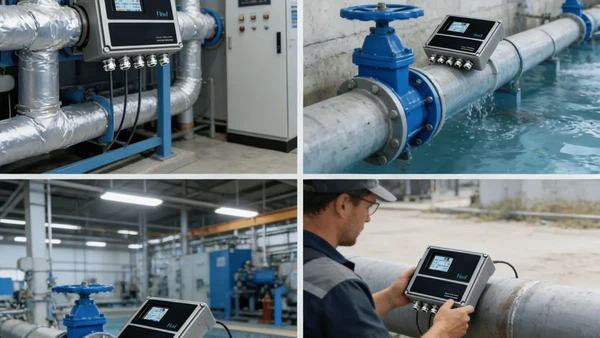
Use this framework as a rapid screening tool before getting into detailed product evaluation:
| If your situation is... | Then consider... |
|---|---|
| Clean liquid, full pipe, and you cannot cut the pipe | Clamp-on transit-time meter - start here |
| Clean liquid, full pipe, and highest accuracy needed | Inline (spool-piece) transit-time meter with factory calibration |
| Clean liquid, large pipe (DN200+), permanent installation | Insertion transit-time meter |
| Temporary measurement, auditing, or meter verification | Portable transit-time meter |
| Liquid with significant solids, slurry, or heavy aeration | Doppler meter, mag meter, or other technology - transit-time is not the right fit |
| Pipe partially full or open-channel conditions | Not suitable for transit-time - consider open-channel or area-velocity meters |
| Old pipe with unknown internal condition | Verify wall thickness and condition first; consider insertion or inline if clamp-on results are poor |
Final Selection Checklist
Before placing an order, confirm that each of these questions has a clear answer:
- Is the pipe consistently full at the measurement location?
- Is the liquid clean enough for transit-time measurement - minimal bubbles, low suspended solids?
- Do you know the actual pipe material, outside diameter, wall thickness, and liner (if any)?
- Is there adequate straight pipe run upstream and downstream?
- What level of accuracy is actually required - trending, energy billing, or custody-level?
- Is a clamp-on meter sufficient, or would insertion or inline provide better confidence?
- Does the meter need to operate in a hazardous area, extreme temperature, or outdoor environment?
- Are the output type, communication protocol, power supply, and display requirements compatible with your system?
- Can the meter be safely accessed for installation and future maintenance?
A thorough selection process answers these questions before the meter ships - not after the readings become questionable in the field.
Frequently Asked Questions
Can a transit-time ultrasonic flow meter measure wastewater?
It depends on the quality of the wastewater. Treated effluent with low suspended solids and minimal entrained air can work well with transit-time technology. Raw, untreated wastewater with high solids or heavy aeration is a poor fit - a Doppler meter or electromagnetic flow meter is typically a better choice for those applications.
How accurate is a clamp-on transit-time flow meter?
Under good conditions - clean pipe, accurate wall data, proper transducer installation, sufficient straight run - many clamp-on meters achieve ±1% to ±2% of reading. However, accuracy degrades with poor pipe conditions, incorrect parameter input, or inadequate installation. For applications requiring tighter uncertainty, inline meters with factory calibration are preferred. See factors affecting clamp-on accuracy.
What causes signal loss in a transit-time meter?
The most common causes are: bubbles or particles in the fluid scattering the signal, incorrect transducer spacing, poor coupling between the transducer and pipe surface, wrong pipe data (especially wall thickness), and severe internal scaling or corrosion. In most field cases, addressing one or more of these issues restores the signal. For more detail, see factors affecting measurement performance.
Can it work on partially filled pipes?
No. Transit-time measurement requires a completely full pipe. If the pipe is not always full, the meter cannot maintain a valid acoustic path across the expected cross-section, and the calculated flow will be incorrect. Applications with partially filled conditions require a different measurement approach.
What is the difference between clamp-on and inline transit-time meters?
Clamp-on meters mount externally - no pipe cutting required - but their performance depends on pipe surface condition, wall characteristics, and correct parameter entry. Inline (spool-piece) meters are integrated into the pipe, with factory-controlled measurement geometry and calibration. Inline meters generally offer better accuracy and long-term stability, but require more installation effort and cost. The right choice depends on the accuracy requirement, installation constraints, and project budget.
Conclusion
A transit-time ultrasonic flow meter is an excellent choice for clean-liquid, full-pipe applications where engineers want reliable flow measurement without pressure loss - and in many cases, without cutting the pipe. It performs especially well in water systems, HVAC energy management, industrial utilities, and portable verification work.
But the best meter is not chosen by product type alone. It is chosen by systematically matching the measurement principle to the liquid condition, confirming the pipe condition supports reliable signal transmission, selecting an installation type appropriate for the accuracy requirement, and verifying that the site environment and system integration needs are met.
In practice, most field problems can be prevented before installation begins. A thorough selection process is not just a purchasing step - it is the foundation of long-term measurement reliability. If you need help evaluating whether transit-time technology fits your specific application, contact our application engineering team for guidance.


