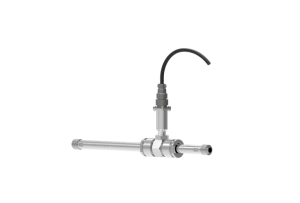
Hey there! As a supplier of liquid meters, I've been getting a lot of questions lately about how pipe diameter affects a liquid meter's measurement. So, I thought I'd take a deep dive into this topic and share some insights with you all.
First off, let's understand the basic working principle of a liquid meter. Liquid meters are designed to measure the flow rate and volume of liquids passing through a pipe. There are different types of liquid meters, such as ultrasonic flow meters, turbine meters, and electromagnetic meters, but the concept of how pipe diameter plays a role is somewhat similar across the board.
The Impact of Pipe Diameter on Flow Profile
One of the key things that pipe diameter affects is the flow profile of the liquid inside the pipe. In a smaller - diameter pipe, the liquid flow tends to be more turbulent. Turbulence occurs when the liquid moves in an irregular and chaotic manner. This is because the walls of the pipe have a greater influence on the flow in a smaller space. The liquid near the pipe walls experiences more friction, which can cause eddies and swirls in the flow.
On the other hand, in a larger - diameter pipe, the flow is often more laminar. Laminar flow means that the liquid moves in smooth, parallel layers. There is less interaction between the different layers of the liquid, and the influence of the pipe walls is relatively less significant.
Why does this matter for liquid meter measurement? Well, most liquid meters are calibrated to work under certain flow conditions. If the flow profile is too turbulent or laminar compared to what the meter is designed for, it can lead to inaccurate measurements. For example, an ultrasonic flow meter that relies on measuring the time it takes for ultrasonic waves to travel through the liquid can be affected by turbulence. Turbulence can scatter the ultrasonic waves, making it difficult for the meter to accurately measure the flow velocity.
Pipe Diameter and Flow Velocity
Another important aspect is the relationship between pipe diameter and flow velocity. According to the principle of continuity in fluid mechanics, the product of the cross - sectional area of the pipe and the flow velocity remains constant (assuming incompressible fluid). Mathematically, it's expressed as (A_1V_1 = A_2V_2), where (A) is the cross - sectional area ((A=\pi(d/2)^2), (d) being the pipe diameter) and (V) is the flow velocity.
This means that for a given flow rate of liquid, if the pipe diameter decreases, the flow velocity increases, and vice versa. A liquid meter that measures flow velocity needs to be able to handle different velocity ranges. In a small - diameter pipe with high flow velocity, the meter may face challenges in accurately measuring the fast - moving liquid. Some meters may have a maximum velocity limit, beyond which they cannot provide reliable measurements.
Conversely, in a large - diameter pipe with low flow velocity, the meter may struggle to detect the slow - moving liquid. The sensitivity of the meter becomes crucial in such cases. If the meter is not sensitive enough, it may not be able to pick up the small changes in flow associated with the low - velocity liquid.
Meter Selection Based on Pipe Diameter
When it comes to choosing the right liquid meter for a specific application, pipe diameter is a major factor. For small - diameter pipes (say, less than 2 inches), meters that can handle high - velocity and turbulent flow are often preferred. For instance, turbine meters can be a good choice as they are relatively compact and can work well in high - velocity environments.
For larger - diameter pipes (more than 6 inches), ultrasonic flow meters are often a popular option. Ultrasonic flow meters can be non - intrusive, which means they can be clamped onto the outside of the pipe without having to cut into the pipe. This is a huge advantage when dealing with large pipes, as it reduces installation time and cost.
We offer a range of liquid meters suitable for different pipe diameters. Our Strap on Water Ultrasonic Flow Meter High Accuracy for Building Automation HVAC is a great option for medium - to large - diameter pipes in building automation and HVAC systems. It provides high - accuracy measurements and is easy to install.
If you're looking for a meter to measure the flow rate of water, our Water Flow Rate Meter is designed to work with various pipe sizes and can accurately measure the flow rate of water in different applications.
And for those who need a non - intrusive solution for measuring water flow in pipes, our Clamp On Water Meter is a fantastic choice. It can be easily clamped onto the pipe and provides reliable measurements.
Installation Considerations
The installation of a liquid meter is also affected by the pipe diameter. In small - diameter pipes, it's important to ensure that the meter is installed correctly to avoid any additional turbulence or flow restrictions. Any misalignment or improper installation can have a significant impact on the measurement accuracy.
In large - diameter pipes, the installation process may be more complex due to the size and weight of the pipe. However, non - intrusive meters like ultrasonic flow meters can simplify the installation process. But even with non - intrusive meters, proper positioning and alignment are crucial for accurate measurements.
Conclusion
In conclusion, pipe diameter has a significant effect on a liquid meter's measurement. It influences the flow profile, flow velocity, and the choice of the appropriate meter. As a liquid meter supplier, we understand the importance of these factors and are committed to providing our customers with the right meters for their specific applications.
If you're in the market for a liquid meter and need help choosing the right one based on your pipe diameter and other requirements, don't hesitate to reach out to us. We're here to assist you in making the best decision for your needs and ensuring accurate and reliable liquid flow measurements.


References
- White, F. M. (2016). Fluid Mechanics. McGraw - Hill Education.
- Miller, R. W. (2010). Flow Measurement Engineering Handbook. McGraw - Hill Education.