


Hey there! As a supplier of Thermal Mass Flow Meters, I often get asked about the differences between inline and insertion Thermal Mass Flow Meters. So, let's dive right into it and break it down in a way that's easy to understand.
First off, let's talk about what a Thermal Mass Flow Meter is in general. These meters measure the mass flow rate of a fluid, typically gases, by utilizing the thermal properties of the fluid. They work based on the principle that the heat transfer from a heated element to the fluid is related to the mass flow of the fluid passing by. It's a pretty nifty technology that has a wide range of applications.
Inline Thermal Mass Flow Meters
An inline Thermal Mass Flow Meter is installed directly in the pipeline. It's like an all - in - one unit that fits snugly within the flow path. One of the biggest advantages of an inline meter is its accuracy. Since it measures the flow across the entire cross - section of the pipe, it can give a very precise reading of the mass flow rate.
The construction of an inline meter is designed to ensure that the fluid flows uniformly through the measuring section. This uniformity helps in getting consistent and reliable results. For applications where high accuracy is a must, like in some chemical processing plants or in research facilities, inline meters are often the go - to choice.
Another benefit is the ease of calibration. Inline meters can be calibrated more precisely because they are measuring the actual flow conditions within the pipe. They are also less affected by external factors such as pipe vibrations or flow disturbances outside the measuring section.
However, inline meters do have some drawbacks. They are usually more expensive than insertion meters. The installation can be a bit more complicated and time - consuming, as it often requires cutting into the pipeline and making proper connections. Also, if you need to replace the meter, you might have to shut down the entire system, which can be costly in terms of production downtime.
Insertion Thermal Mass Flow Meters
On the other hand, an insertion Thermal Mass Flow Meter is inserted into the pipeline through a small opening. It's a more flexible option, especially for larger pipes. You can think of it as a probe that goes into the pipe to measure the flow.
One of the main advantages of insertion meters is their cost - effectiveness. They are generally cheaper than inline meters, and the installation is much quicker and easier. You don't have to cut the pipeline; you just drill a small hole and insert the meter. This makes them a great option for retrofitting existing systems or for applications where budget is a concern.
Insertion meters also offer flexibility in terms of placement. You can choose to place the meter at different depths within the pipe to get a representative reading of the flow. This is useful in situations where the flow profile in the pipe is not uniform.
But there are also some limitations. Insertion meters may not be as accurate as inline meters, especially in pipes with complex flow patterns. Since they only measure a small portion of the flow, there is a possibility of error if the flow is not well - behaved. Also, the calibration of insertion meters can be a bit trickier, as they need to be adjusted based on the pipe size and the flow conditions.
Applications
The choice between inline and insertion Thermal Mass Flow Meters also depends on the application. For example, in a natural gas distribution network, inline meters might be used at key measurement points where high accuracy is required for billing purposes. Meanwhile, in an HVAC system, insertion meters can be a good choice for monitoring the air flow in large ducts due to their cost - effectiveness and ease of installation.
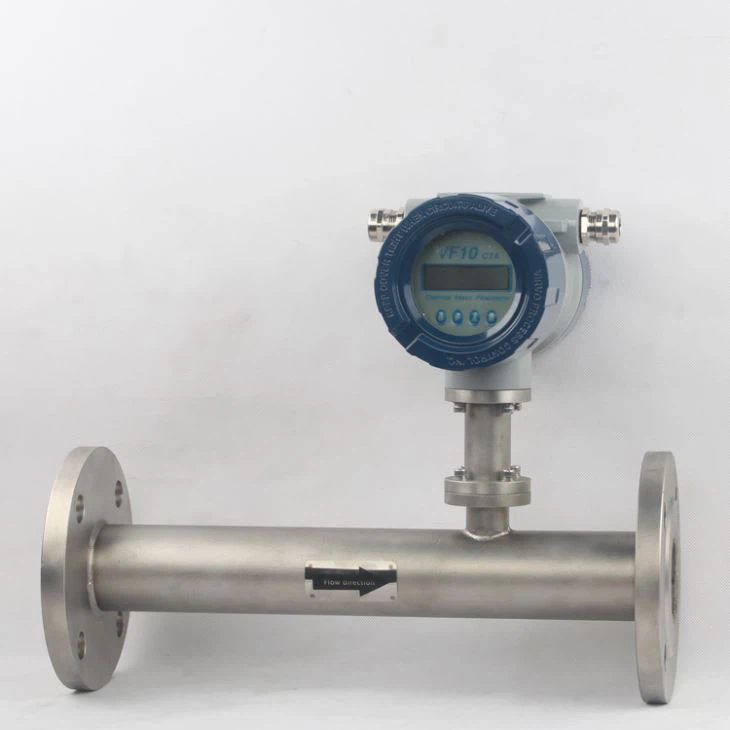

If you want to learn more about the application of thermal mass air flow meters in air measurement, you can check out this resource: Thermal Mass Air Flow Meter Application in Air Measurement.
Quality and Performance
As a supplier, I always emphasize the importance of getting a good quality Thermal Mass Flow Meter. A high - quality meter ensures accurate measurements and long - term reliability. You can find more information about good quality thermal mass flow meters here: Good Quality Thermal Mass Flow Meter.
When it comes to measuring gas, having a thermal mass flow meter with stable performance is crucial. Our meters are designed to provide consistent and reliable results, even in challenging environments. To know more about our thermal mass flow meters for measuring gas, click here: Thermal Mass Flow Meter for Measuring Gas with Stable Performance.
Making the Choice
So, how do you decide which one is right for you? Well, it boils down to a few key factors. Consider the accuracy requirements of your application. If you need highly precise measurements, an inline meter might be the way to go. But if cost and ease of installation are your top priorities, an insertion meter could be a better fit.
Also, think about the pipe size and the flow characteristics. In larger pipes or in systems with non - uniform flow, an insertion meter might offer more practical solutions. And don't forget about the long - term maintenance and calibration needs.
In conclusion, both inline and insertion Thermal Mass Flow Meters have their own pros and cons. As a supplier, I'm here to help you make the best decision based on your specific needs. Whether it's for a small - scale laboratory setup or a large - scale industrial application, we've got the right meter for you.
If you're interested in purchasing a Thermal Mass Flow Meter or want to discuss your requirements in detail, don't hesitate to reach out. We can have a chat and figure out the best solution for your project.
References
- Brown, G. (2018). Flow Measurement Handbook. Elsevier.
- Smith, J. (2020). Introduction to Thermal Mass Flow Meters. Technical Publications.


