What is the behavior of flow vortices near boundaries?
Hey there! As a supplier of flow vortices, I've been diving deep into the world of these fascinating phenomena. Flow vortices are swirling patterns in a fluid, and their behavior near boundaries is a topic that's both complex and super important.
Let's start with the basics. When a fluid flows near a boundary, like the wall of a pipe or the surface of an object, the interaction between the fluid and the boundary creates some interesting effects. The fluid closest to the boundary experiences a frictional force, which slows it down. This creates a velocity gradient, with the fluid moving faster further away from the boundary.
One of the key things that happens near boundaries is the formation of vortices. Vortices are essentially spinning regions of fluid. They can form in a variety of ways, but one common mechanism is the separation of the flow from the boundary. When the fluid flow encounters an obstacle or a change in the shape of the boundary, it can separate from the surface, creating a region of low pressure behind the obstacle. This low-pressure region can cause the fluid to start spinning, forming a vortex.
The behavior of these vortices near boundaries can have a significant impact on the flow characteristics. For example, vortices can affect the drag force on an object. If the vortices are large and well - organized, they can increase the drag, making it harder for the object to move through the fluid. On the other hand, in some cases, well - controlled vortices can actually reduce drag.
Another important aspect is the stability of the vortices. Near boundaries, the vortices can be either stable or unstable. Stable vortices tend to maintain their shape and position for a relatively long time, while unstable vortices can quickly break up or change their shape. The stability of the vortices depends on a number of factors, including the flow velocity, the properties of the fluid, and the geometry of the boundary.
Let's take a look at some real - world applications. In the field of engineering, understanding the behavior of flow vortices near boundaries is crucial for designing efficient systems. For example, in the design of pipes and ducts, engineers need to consider how vortices can affect the flow of fluids. If vortices are not properly managed, they can cause energy losses, noise, and even damage to the system.
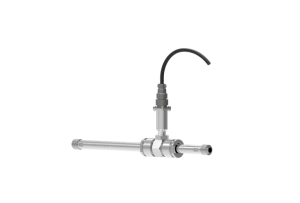
In the case of flow meters, the behavior of vortices is also very important. A Vortex Steam Flow Meter works by detecting the vortices that are shed from a bluff body placed in the flow. The frequency of the vortices is proportional to the flow rate of the fluid. So, by measuring the frequency of the vortices, we can accurately determine the flow rate.
Similarly, a High Temp Insertion Vortex Flow Meter is designed to work in high - temperature environments. The behavior of vortices in these conditions can be different from those in normal - temperature environments. The high temperature can affect the properties of the fluid, such as its viscosity, which in turn can influence the formation and behavior of the vortices.
A Good Performance Vortex Flow Meter for Steam with Calibration is calibrated to ensure accurate measurement of steam flow. The calibration takes into account the specific behavior of vortices in steam, which can be different from other fluids.
Now, you might be wondering how we can control the behavior of flow vortices near boundaries. There are several techniques that can be used. One common method is to use flow control devices, such as vortex generators. These are small devices that are placed on the surface of an object to create or modify the vortices. By carefully designing the shape and placement of the vortex generators, we can control the size, strength, and position of the vortices.
Another approach is to modify the shape of the boundary itself. For example, by using streamlined shapes, we can reduce the likelihood of flow separation and the formation of large, uncontrolled vortices. This can improve the efficiency of the flow and reduce drag.
In addition to engineering applications, the study of flow vortices near boundaries also has implications in other fields, such as fluid dynamics research and environmental science. In fluid dynamics research, understanding the behavior of vortices can help us develop more accurate models of fluid flow. In environmental science, the behavior of vortices in natural water bodies, such as rivers and oceans, can affect the transport of pollutants and the distribution of nutrients.
So, if you're in the market for high - quality flow meters or other flow - related products, we're here to help. Our team of experts has a deep understanding of the behavior of flow vortices near boundaries, and we can provide you with the best solutions for your specific needs. Whether you're dealing with steam flow, high - temperature fluids, or other types of flow applications, we've got you covered.
If you're interested in learning more about our products or have any questions about flow vortices, feel free to reach out. We're always happy to have a chat and discuss how we can help you with your flow measurement and control needs.
References


- White, F. M. (2011). Fluid Mechanics. McGraw - Hill.
- Schlichting, H., & Gersten, K. (2000). Boundary - Layer Theory. Springer.