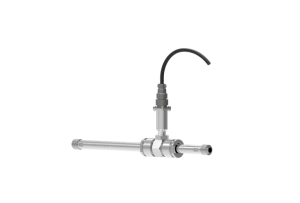
Hey there! As a supplier of thermal mass flow meters, I often get asked how these nifty devices stack up against other types of flow meters. Well, you're in the right place because I'm gonna break it down for you.
First off, let's talk about what a thermal mass flow meter actually does. It measures the mass flow rate of a gas by utilizing the principle of heat transfer. When gas flows over a heated sensor, it takes away heat, and the amount of heat loss is directly related to the mass flow rate of the gas. This is different from other flow meters that might measure volume flow or use other physical properties to gauge the flow.
Comparing with Differential Pressure Flow Meters
Differential pressure flow meters are pretty common. They work by creating a pressure drop across an obstruction in the flow path, like an orifice plate or a venturi tube. The pressure difference is then used to calculate the flow rate.


One of the big advantages of thermal mass flow meters over differential pressure flow meters is that they measure mass flow directly. Differential pressure meters usually measure volume flow, and you need to correct for temperature and pressure to get the mass flow. This can be a hassle, especially in applications where the temperature and pressure of the gas vary a lot.
For example, in a natural gas pipeline, the temperature and pressure can change depending on the time of day, the season, and the location along the pipeline. With a differential pressure meter, you'd have to constantly adjust the readings to account for these changes. A thermal mass flow meter, on the other hand, cuts out this step and gives you the mass flow right away.
Another thing is that differential pressure meters can have a relatively high pressure drop across the obstruction. This means you need more energy to push the gas through the system, which can increase operating costs. Thermal mass flow meters have a very low pressure drop, so they're more energy - efficient. Check out our Gas Mass Flow Meter Air Flow Measure for more details on how our thermal mass flow meters can save you energy.
Comparing with Turbine Flow Meters
Turbine flow meters work by having a turbine in the flow path. The gas or liquid flowing through the meter causes the turbine to spin, and the rotational speed is proportional to the flow rate.
One drawback of turbine flow meters is that they have moving parts. These moving parts can wear out over time, especially if the gas contains particles or debris. This can lead to inaccurate readings and more maintenance. Thermal mass flow meters, on the other hand, have no moving parts. This makes them more reliable and less prone to mechanical failures.
Turbine flow meters also have a limited range of flow rates that they can measure accurately. They work best within a certain flow range, and if the flow rate goes outside of this range, the accuracy can suffer. Thermal mass flow meters have a wider turndown ratio, which means they can accurately measure a larger range of flow rates. Whether you have a low - flow or a high - flow situation, a thermal mass flow meter can handle it. Our Thermal Mass Flow Meter for Measuring Gas with Stable Performance is designed to provide accurate measurements across a wide range of flow rates.
Comparing with Ultrasonic Flow Meters
Ultrasonic flow meters use ultrasonic waves to measure the flow rate. There are two main types: transit - time and Doppler. Transit - time ultrasonic flow meters measure the difference in the time it takes for an ultrasonic wave to travel upstream and downstream in the flow. Doppler ultrasonic flow meters measure the frequency shift of the ultrasonic wave reflected off particles in the flow.
One of the challenges with ultrasonic flow meters is that they require a clean and homogeneous fluid or gas. If there are bubbles, particles, or non - uniformities in the flow, it can affect the accuracy of the measurements. Thermal mass flow meters are less sensitive to these issues. They can work well even if the gas has some impurities or if the flow is a bit turbulent.
Ultrasonic flow meters also need to be installed correctly to work properly. The pipe needs to be straight and have a certain length before and after the meter to ensure a stable flow profile. Thermal mass flow meters are more forgiving when it comes to installation. They can be installed in a variety of pipe configurations and still provide accurate measurements. Our Good Quality Thermal Mass Flow Meter is easy to install and can adapt to different installation conditions.
Applications where Thermal Mass Flow Meters Shine
Thermal mass flow meters are great for a wide range of applications. In the environmental monitoring field, they're used to measure the flow of exhaust gases from industrial plants. They can accurately measure the mass flow of pollutants, which is important for compliance with environmental regulations.
In the semiconductor industry, where precise control of gas flow is crucial, thermal mass flow meters are the go - to choice. They can provide accurate and stable flow measurements, which is essential for processes like chemical vapor deposition and etching.
In the food and beverage industry, thermal mass flow meters are used to measure the flow of gases like carbon dioxide and nitrogen. These gases are used in processes like carbonation and packaging, and accurate flow measurement is necessary to ensure product quality.
Why Choose Our Thermal Mass Flow Meters
As a supplier, we take pride in offering high - quality thermal mass flow meters. Our meters are designed with the latest technology to provide accurate, reliable, and stable measurements. We've put a lot of effort into the design and manufacturing process to ensure that our meters can meet the needs of different industries.
Our meters are also easy to install and maintain. We provide comprehensive support to our customers, from installation guidance to after - sales service. Whether you're a small business or a large industrial corporation, we can help you find the right thermal mass flow meter for your application.
If you're in the market for a flow meter and you're considering different options, I highly recommend giving thermal mass flow meters a closer look. They offer a lot of advantages over other types of flow meters, and our products are a great choice.
If you're interested in learning more about our thermal mass flow meters or if you want to discuss your specific requirements, don't hesitate to get in touch. We're here to help you make the best decision for your business.
References
- Flow Measurement Handbook: Industrial Designs and Applications by Richard W. Miller
- Principles of Flow Measurement by Harry F. Olson