


Are mag meters suitable for measuring slurries? This is a question that often arises in industries dealing with slurries, such as mining, wastewater treatment, and food and beverage. As a supplier of mag meters, I am well - versed in the capabilities and limitations of these devices when it comes to slurry measurement.
Magnetic flow meters, or mag meters, operate on the principle of Faraday's law of electromagnetic induction. When a conductive fluid moves through a magnetic field generated by the meter, a voltage is induced. This voltage is proportional to the flow velocity of the fluid, allowing for accurate flow measurement.
One of the key advantages of mag meters in slurry measurement is their non - intrusive nature. Unlike some other flow measurement devices, mag meters do not have any moving parts in the flow path. This means that there is less risk of wear and tear caused by the abrasive nature of slurries. For example, in a mining operation where slurries contain large amounts of sand and ore particles, a traditional mechanical flow meter would quickly experience damage to its moving components. In contrast, mag meters can operate smoothly without being affected by the abrasive particles in the slurry.
Another benefit is the wide range of materials available for the liners and electrodes of mag meters. The liner is the part of the meter that comes into contact with the slurry, and different materials can be chosen based on the chemical properties of the slurry. For instance, in applications where the slurry is highly acidic, a PTFE (polytetrafluoroethylene) liner can be used due to its excellent chemical resistance. Similarly, the electrodes can be made of materials like stainless steel or Hastelloy, which are resistant to corrosion and abrasion. This flexibility in material selection makes mag meters suitable for a variety of slurry types.
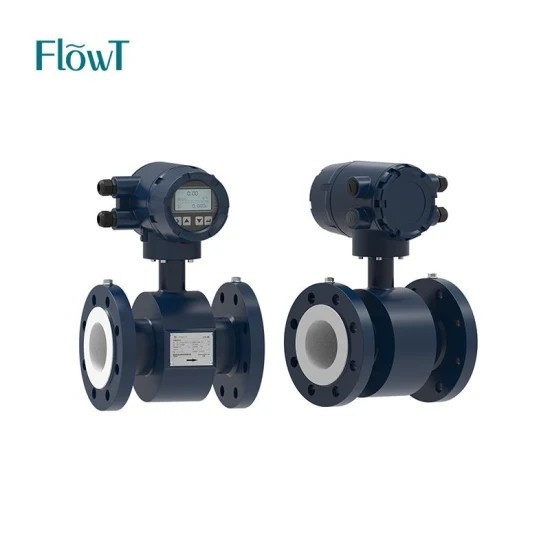

However, there are also some challenges when using mag meters for slurry measurement. One of the main issues is the presence of air bubbles in the slurry. Air bubbles can disrupt the magnetic field and cause inaccurate flow readings. To mitigate this problem, proper installation techniques are crucial. For example, the mag meter should be installed in a location where the flow is fully developed and there is minimal chance of air entrainment. Additionally, the use of air eliminators upstream of the mag meter can help to remove air bubbles from the slurry before it reaches the meter.
Another challenge is the potential for coating or scaling on the electrodes. Slurries may contain substances that can form a layer on the electrodes over time, which can affect the accuracy of the measurement. Regular maintenance and cleaning of the electrodes are necessary to prevent this. Some mag meters are designed with self - cleaning features, such as ultrasonic cleaning systems, which can help to keep the electrodes free from coatings.
When considering the suitability of mag meters for slurry measurement, it is also important to look at the accuracy requirements of the application. Mag meters can generally provide accurate flow measurements within a certain range. For most industrial applications, an accuracy of ± 0.5% to ± 2% of the measured value is achievable. However, in applications where extremely high accuracy is required, additional calibration and verification may be necessary.
In the market, there are different types of mag meters available for slurry measurement. For example, the Electromagnetic Water Flow Meter for Measuring Flow Capavitive is designed to handle conductive fluids and slurries with high precision. It offers reliable performance even in harsh industrial environments. The Insertion Flow Meter manufacturer provides insertion - type mag meters that are easy to install and can be used in large - diameter pipes for slurry flow measurement. And the China Factory Promotions DN4 - DN2000mm Electromagnetic Flowmeter offers a wide range of sizes, which is suitable for various slurry applications from small - scale to large - scale industrial processes.
In conclusion, mag meters can be a suitable choice for measuring slurries in many industrial applications. Their non - intrusive design, wide range of material options, and relatively high accuracy make them a popular option. However, it is important to be aware of the challenges such as air bubbles and electrode coating, and to take appropriate measures to ensure accurate and reliable measurement. If you are in the market for a mag meter for slurry measurement, I encourage you to reach out to discuss your specific requirements. Our team of experts can help you select the most suitable mag meter for your application and provide you with the necessary support for installation, calibration, and maintenance. Contact us today to start the procurement and negotiation process.
References
- Spitzer, D. W. (2001). Flow Measurement: Practical Guides for Measurement and Control. ISA - The Instrumentation, Systems, and Automation Society.
- Beck, M. S., & Plaskowski, A. (1987). Flow Measurement Using Electromagnetic Techniques. Adam Hilger.


