low Meter Calibration Equipment for Accurate and Traceable Testing
FlowT Flow Meter Calibration Equipment is designed for flow meter manufacturers, calibration laboratories, metrology facilities and industrial instrumentation companies that need controlled, repeatable and documented flow meter testing.

The system can be engineered around the required calibration method, flow range, pipe size, test medium, meter type and automation level. Depending on the confirmed project configuration, the calibration platform can integrate reference measurement, flow control, test pipelines, data acquisition and calibration reporting into one engineered solution.
Send FlowT your required flow range, meter sizes, test medium, target uncertainty and calibration method for a project-based technical review.
Project-based flow calibration system design
1
>>
Suitable for multiple flow meter technologies
2
>>
Controlled multi-point calibration
3
>>
Reference-meter or alternative calibration methods
4
>>
Automatic data acquisition and report generation options
5
>>
Configurable flow range and test pipeline
6
Build Calibration Capability Around Your Own Production and Laboratory Workflow
Sending Every Meter to an External Laboratory Takes Time
External calibration can create additional transportation, scheduling and turnaround requirements, especially for manufacturers testing large quantities of flow meters.An in-house calibration system can help integrate verification directly into production, quality control or laboratory operations.
01
One Calibration Range Cannot Cover Every Meter
Different electromagnetic, ultrasonic, turbine, vortex and other flow meters may require different pipe sizes and flow conditions.FlowT can review the required test range and help configure calibration lines according to the actual meter portfolio.
02
Manual Data Processing Creates Additional Work
Recording every test point manually increases operator workload and creates additional opportunities for transcription errors.Automation and data-acquisition options can help streamline test-point control, error calculation and calibration-report preparation.
03
Buyers Need Traceable Test Results
A calibration number alone provides limited value if the reference standard, calibration method and measurement conditions are not documented.The FlowT system can be configured around defined calibration procedures and documentation requirements according to the confirmed project.
04
Select the Calibration Method According to Your Measurement Requirement
Different laboratories and meter manufacturers may use different calibration methods depending on the required measurement uncertainty, flow range, medium and available reference standards.
Master Meter Method
The meter under test is installed in series with a calibrated reference flow meter. Stable flow is passed through both devices and the readings are compared at defined flow points.This method is widely used where flexible flow ranges, efficient operation and repeatable production testing are important.
Gravimetric Method
The test liquid is collected over a measured time interval and weighed using a calibrated weighing system. The measured mass is converted into flow using the required fluid-property corrections and test conditions.Gravimetric systems can provide a strong metrological basis for laboratories requiring high-level reference measurement.
Volumetric Method
A known liquid volume is collected or displaced over a defined time period and compared with the meter under test.The final calibration method should be selected according to required uncertainty, standards, meter type and project budget.
Ask FlowT to Review the Right Calibration Method
Typical Flow Meter Calibration Equipment Configuration
A project-specific FlowT calibration system may include the following functional modules according to the confirmed design:
Water / Test Fluid Reservoir
Provides the working-fluid storage capacity required for a closed-loop calibration system.
Pump and Circulation System
Creates controlled flow through the calibration line and supports the required operating range.
Flow Regulation
Control valves, variable-frequency drives or other regulation components help establish stable calibration points.
Reference Measurement
A calibrated master meter, weighing system, volumetric standard or other confirmed reference method provides the comparison value.
Meter-Under-Test Section
Interchangeable pipeline sections, flanges, adapters or clamping mechanisms can be configured for the required meter sizes.
Pressure and Temperature Measurement
Additional sensors can monitor test conditions where pressure or temperature data are needed for calibration calculations.
Data Acquisition
Measurement signals from reference instruments and meters under test can be collected for comparison and calculation.
Calibration Software
Where automation is included, the software can manage test points, record results, calculate error and support calibration-report generation.
Designed for Multiple Flow Meter Technologies
Depending on the confirmed system configuration and calibration range, Flow Meter Calibration Equipment can be engineered for testing different flow-meter technologies.

Suitable for water and conductive-liquid flow meter production and verification lines.
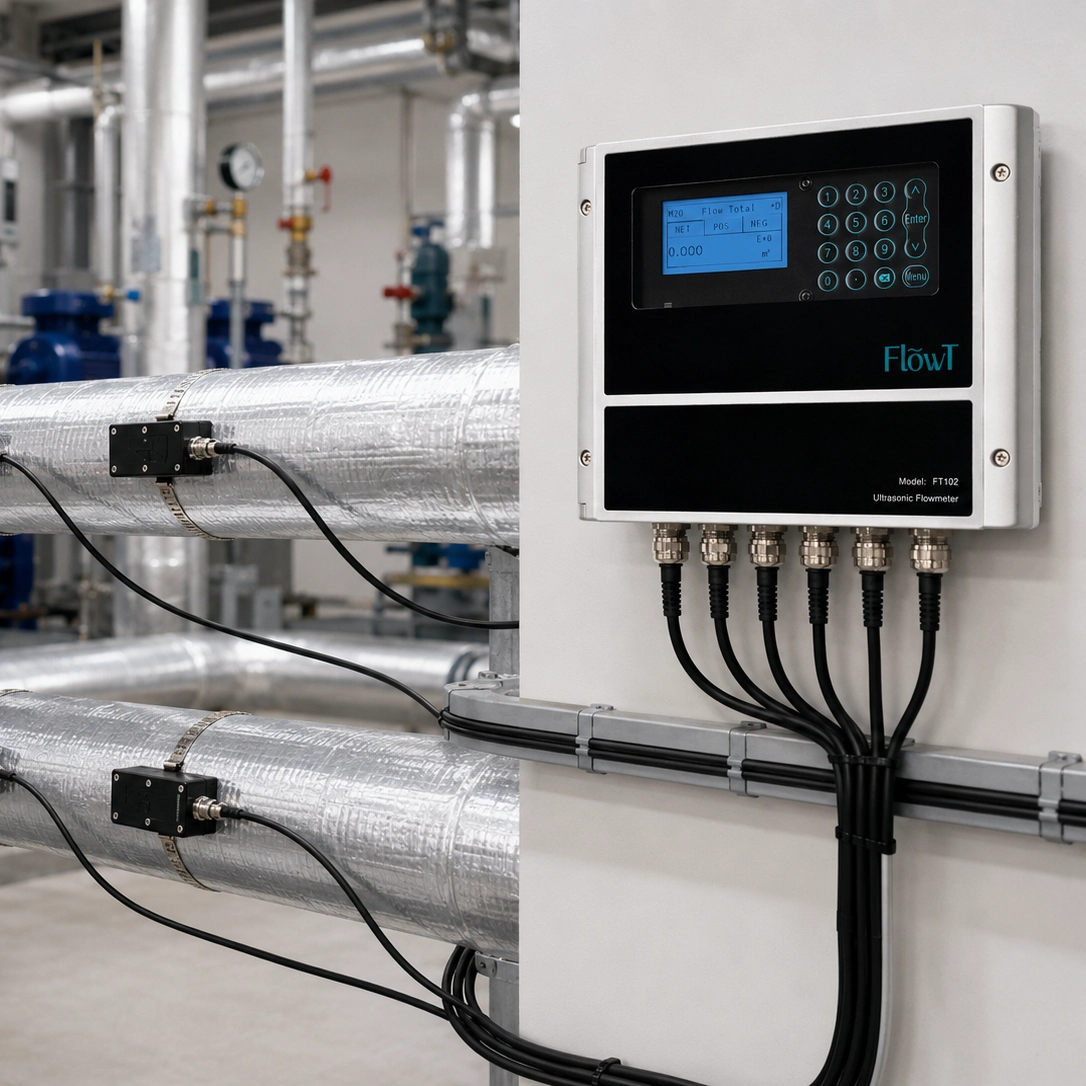
Suitable for water and conductive-liquid flow meter production and verification lines.

Provides repeatable flow points for comparison and calibration across the meter operating range.

Can support liquid-flow verification where the calibration medium and operating conditions are suitable.

Suitable reference methods can be selected according to displacement meter flow range and liquid properties.
Tell Us Which Flow Meters You Need to Calibrate
Specifications
| Category | Parameter | Specification |
|---|---|---|
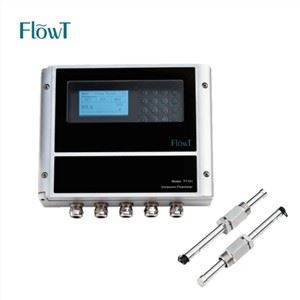
| General | Series Product Name | FT Series Ultrasonic Flowmeter |
| Product Model | FT101 | |
| Fluid | Single Medium Liquid | |
| Performance | Flow Range | ±0.01 m/s ~ ±12 m/s |
| Accuracy | ±0.5% of Reading | |
| Repeatability | 0.1% of Measured Value | |
| Linearity | ±0.5% | |
| Pipe Size | 25 mm ~ 5000 mm | |
| Output & Communication | Pulse Output | 0 ~ 9999 kHz, OCT |
| Analog Output | 4 ~ 20 mA, Max. Load 750 Ω | |
| Communication | RS232 & RS485 | |
| Power Supply | 90 ~ 245 VAC, 48 ~ 63 Hz, or 10 ~ 36 VDC | |
| Environment & Display | Humidity | Up to 99% RH, Non-Condensing |
| Transmitter Temperature | -40°F ~ 140°F | |
| Transducer Temperature | -40°F ~ 176°F / 32°F ~ 356°F | |
| Display | 240 × 128 Backlit LCD |
FAQ
Q: What is flow meter calibration equipment?
A: Flow Meter Calibration Equipment creates controlled flow conditions so the reading of a meter under test can be compared with a known reference. A complete system may include pumps, pipelines, reference instruments, control valves, data acquisition and calibration software.
Q: What flow meters can be calibrated?
A: Depending on system design, calibration equipment can be configured for electromagnetic, ultrasonic, turbine, vortex, Coriolis, positive displacement and other flow meter technologies.
Q: What calibration method should I choose?
A: The appropriate method depends on the test medium, flow range, meter type, required uncertainty, laboratory standards and budget. Master-meter, gravimetric and volumetric methods are common options for liquid-flow calibration.
Q: Can the system be customized?
A: Flow meter calibration benches are typically project-specific because meter diameters, flow ranges and accuracy requirements vary significantly. FlowT recommends providing the full test requirement before system design.
Q: What information is required for a quotation?
A: Please provide test medium, meter type, minimum and maximum flow, pipe size range, required uncertainty, operating pressure, automation level, calibration method if specified, destination and available installation space.
Q: Can the system generate calibration reports?
A: Automated data acquisition and report generation can be included according to the confirmed control and software configuration.
Q: Can one system calibrate several flow meter sizes?
A: Yes, a project can be designed with multiple test sections or adapters when different nominal diameters need to be covered. The final range depends on the hydraulic and reference-system design.
Q: Is automatic calibration available?
A: Automatic or semi-automatic test sequencing can be considered, including flow-point control, data acquisition, calculation and reporting. Final automation scope should be defined during project engineering.
Q: Can FlowT provide installation and commissioning support?
A: Installation, commissioning and operator-training requirements can be discussed during project quotation based on the system complexity and destination.
Q: What standards can the calibration system follow?
A: The applicable standards depend on calibration method and product type. ISO 4185 is one commonly referenced standard for liquid-flow measurement by weighing. Additional standards should be confirmed according to the project.
Hot Tags: Flow Meter Calibration Equipment, ultrasonic flow meter for aquaculture, ultrasonic flow meter for slurries, flow meter ultrasonic, ultrasonic flow meter for sewage, industrial ultrasonic flow meter, ultrasonic flow meter importer